


Basketball Plays - Simple 3-2 Motion Offense Plays
By Dr. James Gels, from the Coach’s Clipboard Basketball Playbook
First read "Motion Offense Principles" and 3-Out 2-In Motion Offense. Use these simple plays with the 3-2 motion offense - simple enough for even youth teams. There are also links below to many more plays that can be used with the 3-2 offense.
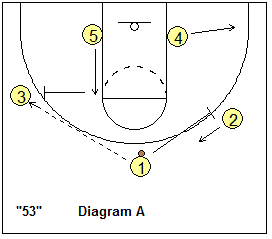
"53"
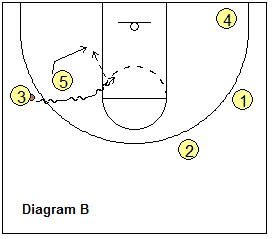
This simple wing ball-screen play is difficult to defend. O1 passes to O3 (diagram A). O5 slides up to the ballside elbow and then ball-screens for O3, and the pick and roll is on. O3 dribbles around the screen as O5 seals and rolls to the hoop.Notice that we have cleared out the weakside, hoping to occupy their helpside defenders. O1 screens for O2 and they exchange spots. For spacing, O2 locates a little to the right at the lane line extended slot. O4 moves out to the short corner. O1 might have a kick-out pass to O2 or O1. You can run this play to the right side too and call it "42".
"43"
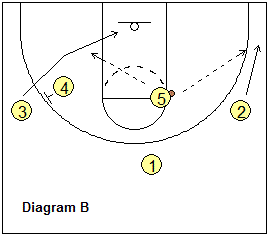
This is a back-screen play designed to get the back-cutter open for a lay-up. O1 passes to O2 (diagram A). O5 screens for O4. O4 back-screens for the opposite wing O3. After screening, O5 flashes to the high post for the pass from O2. O3 back-cuts for the pass from O5 (diagram B). Optionally, O5 could shoot, drive, or pass to O2 (now in the corner), or across to O4 (spotting up on the left wing).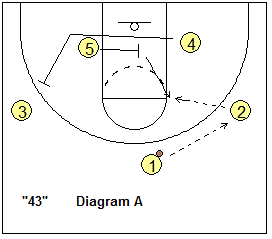
"Double Curl" or "Wheel"
The curl cut can be difficult to defend. O1 passes to O2. O4 moves to the opposite elbow to act as a screener. O3 moves down toward the baseline. O5 curls around O4 for a pass from O2 (and clears back to his original short corner if he doesn't get the pass). After O5 cuts, next O3 curls around O4's screen for the pass from O2 (and clears to the opposite corner). Finally, O4 delays, seals, and cuts into the paint for the pass from O2.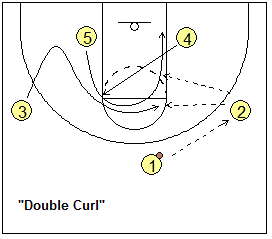
"Blue"
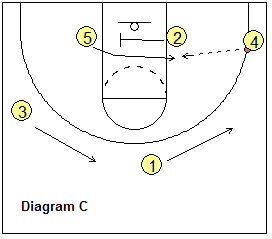
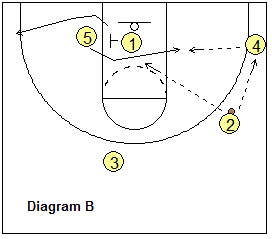
A simple play for youth teams, using the 3-out, 2-in set (you can also run it from the 4-Out set). O1 passes to O2 (diagram A), and O2 passes to O4 in the corner. O2 makes a lane cut and could get the pass from O4 for a lay-up (diagram B). If the pass is not there, O2 screens for O5 (diagram C). O5 cuts to the ball-side block and gets the pass from O4. Notice that after O2 cuts, O1 and O3 rotate to fill the spots.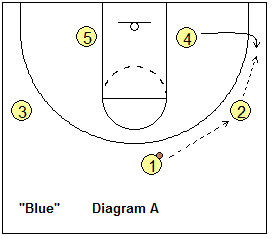
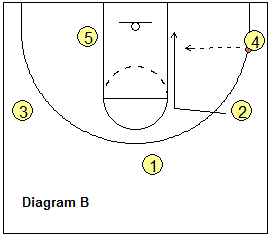
"Red"
This is a simple effective play, used with the 3-out set, or the 4-Out set. O1 passes to O2 and makes a basket-cut, looking for the pass back from O2 ("give and go"). If the pass is not there, O1 "chips" or bumps the X5 defender and O5 cuts around the screen (diagram B), looking for the quick pass from either O2 or O4. After screening for O5, O1 moves to the opposite corner-wing and O3 rotates up top.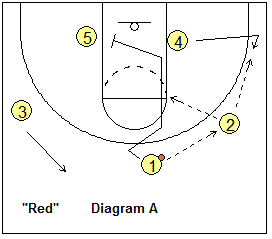
"3-2 Reverse"
Do you have a good post player who can score in the low block, but is not getting the ball often enough. Are you having difficulty getting the pass from the point guard to the wing? This simple play should help both. Our post players O4 and O5 start at the wing positions (diagram A) and O2 and O3 start at the low blocks - just the "reverse" of their normal positions. O4 and O5 down-screen for O2 and O3. O2 and O3 cut hard to the wings for the pass from O1.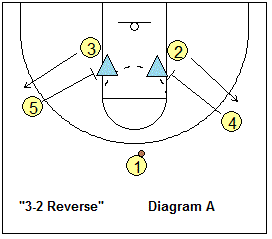
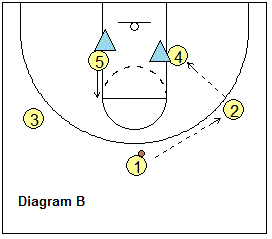
After O2 and O3 cut around the down-screens, O4 and O5 pivot and seal their defenders to post-up for a quick pass from the wing (diagram B). The passes from O1 to O2 and from O2 to O4 should be made quickly, like a "quick hitter". You can run this to either side with the initial pass going to either O2 or O3. Once the post opposite the ball sees the pass going to the opposite wing, he/she moves to the elbow to take his/her defender up high (removing the helpside).
An advantage of using "Reverse" over simply passing into the low post is that often the defense switches the down-screen, and you get a "big-little" mismatch in the post. Have your post players practice their low post moves with these low post drills.
Also see these plays:
- 32 Hi-Lo Plays
- Basketball Plays for the 3-Out, 2-In Motion Offense... Kentucky, MSU, OSU, Wisconsin, Slip, Texas
- Michigan
- 90 Series
- 2-Series - (plays for your shooting guard)... Kansas, Jayhawk, Louisville, Arizona, Arizona and Back, 42 & 52, Illinois, Virginia, and Elevator
- Loyola
- Weave-Screen Plays
- 32 Option Series
