




How to Teach Basketball by Drill Progression
By Dr. James Gels, From the Coach’s Clipboard Basketball Playbook"Helping coaches coach better..."
Disclosure: This page contains affiliate links, which means that Coach's Clipboard receives a small commission (at no cost to you) if you make a purchase using these links.
This article discusses how we teach various aspects of the game using a drill progression method. We break things down into parts, drill those parts, and then put it all together. We start with individual 1-on-1 drills, progressing through 2-on-2, 3-on-3, 4-on-4, and finally 5-on-5. Many of our drills are competitive, with losers running or doing push-ups.
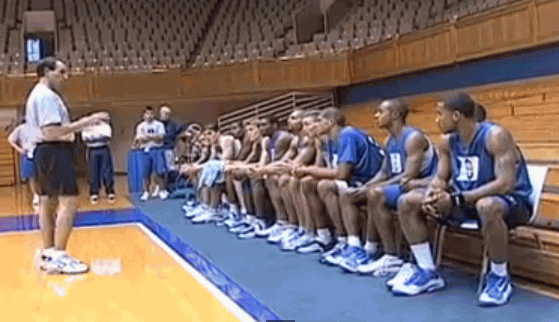
Teacher - Mike Krzyzewski
Teaching by progression is especially useful early in the season when you are introducing something new, whereas later in the season, you can focus more on certain aspects and details that need more practice and re-inforcement.
The drills listed below are also in the Coach's Clipboard's drills section.
Progression for teaching your half-court offense and plays
First, we will teach our basic half-court motion offense. We break this down with perimeter players on one end of the court, and post players on the other, and will breakdown for 15-20 minutes each practice. We use drills outlined on these pages:5-on-5, full-court drill
We use this 5-on-5 drill for putting it all together. Flowing into your motion offense after running your fast break or secondary break is more game-like, and is better for conditioning. In this scrimmage-like drill, both teams play man-to-man defense, and will fast break and score in transition whenever possible.
If a team scores off the break, the action is stopped and they get the ball back, at the top, in their half-court set, and will run the motion offense. Additionally, any time the fast break is stopped, our point guard will call out and execute the motion offense. We play to 7 baskets, and losers run or do push-ups. All of our drills are competitive.
Similarly, we teach our zone offense(s). We will first demonstrate, our "Zone-23" offense, or our "Zone-2" offense, and point out what we are trying to do, how we want to attack the zone, rules, etc. Then we run our 5-on-5, full-court drill as above with the same rules (running the offense after the break), except now both teams are playing zone defense and zone offense.
When teaching new half-court plays, we will demonstrate in the half-court and run through the various options. Then we will split the squad and go 5-on-0 on each end of the court, calling out and executing the plays. Our next practice, we will run the plays out of the secondary break, using our 5-on-0 down-and-back drill, running a different play each trip.
Then the next 5 players does the same. We will then run our 5-on-5 full-court drill as above, with both teams playing man-to-man defense, and the offense running plays. To disguise the plays from the defense, we periodically allow each team a quick 20-second huddle, so they can call their plays (for example, our "Carolina" play might be called "play-1" or some color, while "Kentucky" could be "play-2").
On subsequent practices, our offensive drill progression may look like this:
- 1-on-1 drill
- Guard Breakdown Drills
- Motion Offense Drills
- Post Player Breakdown Drills
- 5-on-0, 5-trips drill (secondary break)
- 5-on-0, down-and-back drill - run m2m plays
- 5-on-0, down-and-back drill - run zone plays
- 5-on-5, run motion (vs M2M, competitive)
- 5-on-5, run plays (vs M2M, competitive)
- 5-on-5, run zone offense and zone plays (vs zone, competitive)
If our next opponent plays mainly man-to-man defense, we will spend most of our 5-on-5 time on motion offense and man-to-man plays. If the next opponent is a zone defensive team, most time will be spent on the zone offense and plays.
Progression for teaching your press offenses
Early in the season, we teach our three press offenses, "80" (vs full-court press), "60" (vs 3/4-court press), and "40" (vs 1/2-court press). We usually teach all three in the same practice, as there as similarities in the three offenses in terms of rules and alignments.We start with teaching the full-court "80" press offense. We demonstrate the player alignment, discuss the rules, and then run it 5-on-0. We will then drill it 5-on-5 with the defense in a 1-2-1-1 diamond full-court press.
Next, we progress to the "60" press break, and finally the half-court "40" press offense, drilling each as above with initially 5-on-0, and then 5-on-5. When drilling the "60" press offense 5-on-5, the defense sets up in a 2-2-1 press. When drilling the "40" press offense, the defense uses the 1/2 court Viking press (1-2-2).
The progression for teaching the "80", "60" and "40" press offenses would look like this:
- Demonstrate "80" press offense
- "80" press offense, 5-on-0 full-court down and back
- "80" press offense, 5-on-5 vs 1-2-1-1 press
- Demonstrate "60" press offense
- "60" press offense, 5-on-0 full-court down and back
- "60" press offense, 5-on-5 vs 2-2-1 press
- Demonstrate "20" press offense
- "20" press offense, 5-on-0 full-court down and back
- "20" press offense, 5-on-5 vs 1-2-2 Viking half-court press
Progression for teaching your half-court man-to-man defense
First, see "Man-to-Man Pressure Defense" to understand how to play this defense. There are many break-down drills that we use.First, we teach individual man-to-man, 1-on-1, on-ball defense containing the offensive player. Next we teach...
Teacher - Bob Knight
Sign up now!
The complete article also includes:
- Eleven steps for teaching man-to-man defense and additional drills
- Nine breakdown steps for teaching how to defend screens
- Progression for teaching the full-court match-up press system - seven steps
- Progression for teaching transition offense - becoming a running team with the primary and secondary breaks - six steps
Create your own drill progressions for teaching whatever team skill, offense or defense that you use. For example, if you teach zone defense or match-up zone defense, break it down and create a drill progression. You can use these same drill progressions from year to year, and for your freshmen, JV and varsity teams.
If you teach these progressions all the way through your program, by the time your players reach the varsity level, they will already have a good understanding of your system... then, with your basic system in place, you can fine tune things, add more details, and things become even more fun!
Related page: Planning Practices
