




Basketball Plays - Last Second, Full-Court "Buzzer-Beater" Plays
By Dr. James Gels, From the Coach’s Clipboard Basketball Playbook"Helping coaches coach better..."

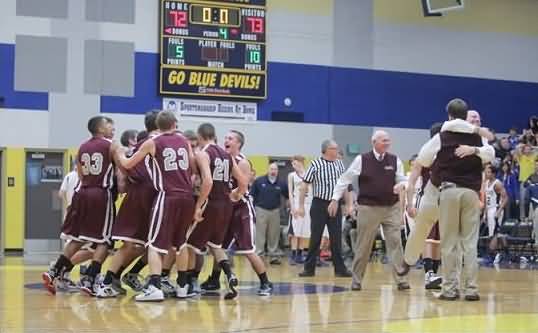
Winning at the buzzer!
Which play you use depends on how much time is left, your team's strengths (best scorers), whether you need a two or three-point shot, and how many time-outs you have left. Using one of these plays does not necessarily have to be at the end of the game, but could also be used at the end of any period.
A "3" counts just as much at the end of the half as it does at the end of the game, and can be a big momentum boost at the end of the half. Like any plays, you must explain and practice these, and get a sense of the time factor. Kids like practicing these "situation plays".
"Maryland"
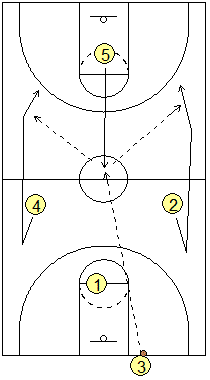
You only have a few seconds left and must go the length of the floor, and you need a three-pointer. This play might at least get you a final shot.Setup:
We start in our usual "80" press break, so the defense thinks the pass will go to O1, who is actually a decoy.
Running the play:
On "go", O5 cuts hard to the half court line and receives the long pass. O2 and O4 take a couple steps toward the ball and then back-cut to the three-point arc on either side. O5 catches the ball, pivots and fires the pass to either O2 or O4, who gets the shot for the three-pointer.
It's a desperation attempt, but it may at least give you a chance to pull it off!
"Split"
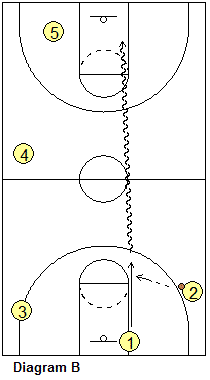
To run this play, you need more than 5 or 6 seconds left in the period (game). It is probably less risky than "Maryland" above and is better for getting a two-point shot (or a foul on the drive to the hoop). Get the ball to your best player... in this example, we give it to our point guard O1. This play will put some pressure on the defense, who is trying not to foul, and yet trying to stop your best player.O1 is the inbounder. O3 and O2 break in opposite directions for the inbounds pass. O1 passes to either O2 or O3, sprints through and gets the return pass from O2 or O3, and speed-dribbles up the floor trying to find a seam and must take that last shot - there usually won't be time for a pass. We yell the seconds out as they are counting down, to help let O1 know how much time is left. But O1 must have a sense of the time as opposing fans will also be yelling.
If O1 is denied, the player with the ball (O3 or O2) will have to speed-dribble and make the play.
O4 splits opposite and runs wide up the sidelines. O5 goes deep, and could get the pass from O1 (if there is enough time).
"Hail Mary"
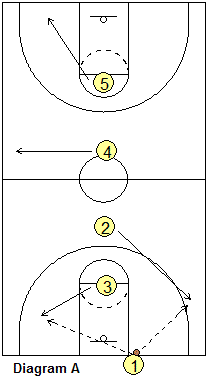
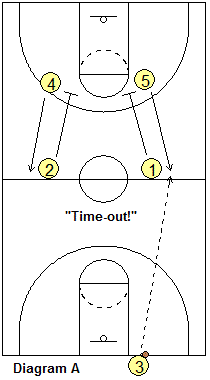
Here's the situation... the game is tied, or your team is down 1 or 2 points, with 3 or 4 seconds left in the game (not enough time to run "Split"). You have one time out left. You must go the full length of the floor.Break the remaining time up into two segments. Since the clock doesn’t start until a player touches the ball, first cut the court into two and make the pass to half-court and immediately call time-out. While you are explaining the play to your team, have your assistant go over to the ref and inform him quietly what you are doing, and that you will be calling time-out and want the clock stopped immediately. This puts the ref on the spot and he won’t be able to say that he didn’t hear you call time-out. Ask the ref also to inform the clock-keeper. If done correctly, you should only lose 1 second with the pass to half court.
See Diagram A. O1 and O1 are at half-court and O4 and O5 are deep. O1 and O2 set down-screens for O4 and O5, and O4 and O5 cut hard up to half-court. O3 is your best long passer. Call time-out as soon as the ball is caught.
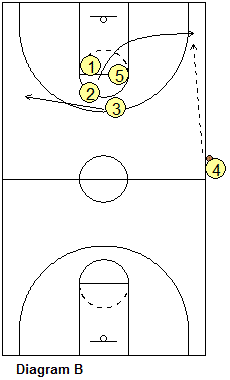
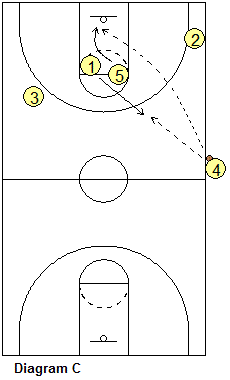
Now, you have the ball on the sideline at half-court with two or three seconds left on the clock. Now you can run any half-court buzzer-beater play.
See diagrams B and C. This example shows your best options for a clear shot at the (1) ball-side corner, (2) weak-side wing (using a skip pass), the lob to your tall post player in the lane, or your point guard coming back to the 3-point line. You must instruct your players that whoever receives the ball, must shoot… there is no time for a pass or dribble.
Set your players up in a tight "diamond" formation. Have your best shooter O2 cut through the diamond to the ball-side corner for the pass and shot. Have another good outside shooter O3 cut to the weak-side wing, looking for the skip pass and three-point shot. O1 cuts toward the ball, 3-point arc area, while O5 tries to get position for the long lob pass to the lane.
O4 is the inbounder and must find the open receiver. If no-one is open, O4 should make the lob pass to O5, hoping that there could be contact and a foul going for the pass… you could win it at the free-throw line.
The odds are against you, but at least you have a chance if you have a plan, and have practiced for this situation.
"Duke"
This is a last second, full-court inbounds play that can be used when there are only a few seconds or less left on the clock. The plan is to pass the ball beyond half-court, and this saves time since the clock doesn't start until the ball is touched.The long pass, the big man (O4), and the long pass reception are keys. The opposing coach is usually yelling "no foul!", so the defense is usually not very aggressive.
Setup as seen in the diagram. O4 starts low and sprints up above the 3-point line. O3 will make the long pass to O4. If there is a tall defender on O3, and if the ball is being inbounded after a made basket, O3 can run the baseline in order to get the pass off.
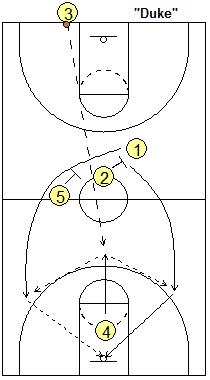
Meanwhile, O2 and O5 set a double-screen for O1. O1 sprints around the double-screen to the right wing, looking for the pass from O4 and the quick shot. After screening, O2 sprints to the left wing, and is often open for the pass and immediate shot. Finally, O4 may have to take that last shot (like Christian Laettner, Duke over Kentucky, 1992 NCAA final game).
It requires a small miracle, but at least it gives you a chance!
"Lion"
Use this play when there is less than 4 seconds remaining. Diagram 1 shows the set-up. Assuming O3 is right-handed, he/she starts on the left baseline area. O4 fakes a screen for O1 and releases up the court. O1 sprints up to the baseline and sets a back-screen on O3's defender, as O3 runs the baseline to the right side. O1 could get fouled if the X3 defender runs over him/her, which is great if you are in the bonus. O3 makes the long pass to O2 on right wing.O5 initially screened for O2 and O2 cuts to the wing for that long pass. Depending on how much time is left (clock does not start until O2 touches the ball), O2 could shoot the 3-pointer (diagram 2), or pass into O5 for the quick post move, or aggressively dribble-drive to the middle (diagram 3), realizing that the defense will be avoiding the foul.
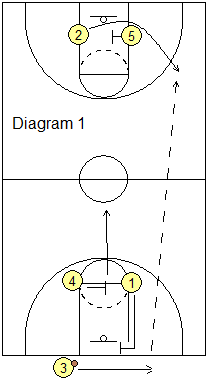
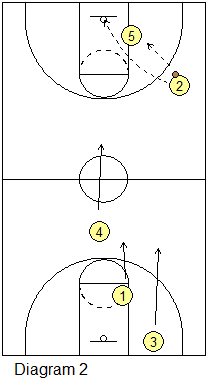
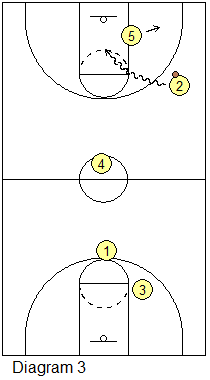
The keys to the plays, and the difficulties, are O1 trying to draw the foul on X3, and being able to throw the long pass accurately.
Related page: Last Second Situations.
