Here are three trapping strategies that we have used with our full-court matchup press. These techniques can apply to any full-court press.
"Cut and Double"See the diagram below. Use "cut and double" along the sidelines. X5 forces O1 to speed-dribble up the sideline, and then sprints ahead of and "cuts" (stops) O1 somewhere along the sideline. This could happen either before or beyond the half-court line. X4 runs along with his/her man, even with the ball. As soon as O1 is stopped, X4 sprints over to trap O1. Oftentimes, O1 will spin backwards away from X5 and toward the sideline, creating an opportunity for X4 to trap or steal the ball, since O1 while spinning is "blind" to the trap coming from behind.
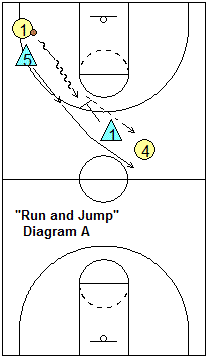
"Run and Jump" One of our press rules is to run at and stop the ball anytime the ball is being speed-dribbled toward you. This could happen in the middle of the court, or along the sideline. Ordinarily, we only trap along the sidelines, not in the middle. In the middle, we "run and jump".
In the diagram below, O1 speed-dribbles toward the middle, at X1. X1 sprints at O1 and contains the ball. If O1 immediately passes to O4, the defenders switch and X5 "jumps" to cut and contain O4, while X1 now has O1. It is easier for X5 to jump to O4 because X5's momentum is going in that direction. It would be nearly impossible for O1 to turn around and sprint back to O4. So a "run and jump" is basically a defensive switch that occurs when the ball is being speed-dribbled at someone, and then passed.
"Run and Double" A "run and double" also occurs when the ball is being speed-dribbled at someone, usually up the sideline (since we don't usually trap in the middle). As the ball is speed-dribbled up the sideline (diagram below), our X1 defender comes up and "hits" O1, and X1 and X5 trap O1. Our X3 helpside defender rotates over to intercept the next pass up the sideline, while our X2 helpside defender sprints back to defend the paint.
There are a few situations where we may "run and double" in the open court: (1) the speed-dribbler stops his dribble and we stay in the trap, (2) when the ball-handler is not a great dribbler and folds under pressure, and (3) at times, we will "run and double" whenever their best player receives the ball, just to make him/her work harder and give up the ball.
Note that a "run and double" becomes a "run and jump" as soon as the ball is passed out of the double-team.
Coach's Clipboard Premium Membership - join today! Immediate online access, comprehensive downloadable playbook included with offenses, defenses, plays, drills, coaching and player tips, animated diagrams, video clips, mobile-ready, pdfs for print-outs, and more! More info...
Coaches... get a group membership (deeply discounted) for all your coaches!
Your input is needed! Do you have a suggestion(s) for future website or newsletter topics? Email Coach's Clipboard.