Today's Quote: "Desire outweighs footwork when it comes to crashing the glass." - Bill Self
Today's Theme...Offensive Rebounding vs Transition Defense
Offensive rebounding and transition defense are seemingly often at odds. Teams must balance the desire for extra possessions with offensive rebounds versus the need to get back and prevent easy baskets in transition.
If you watch the pros, most teams stress getting back on defense because their opponents have very talented, fast players who can handle the ball, attack and shoot the 3 with a high percentage.
At the high school and youth levels, your opponents may not fast break at all. Or if they do, are not as skilled and fast as elite players, and may have only one or two players who are good outside shooters. And many cannot finish consistently at the hoop off a fast speed dribble or quick pass. Thus, they are less of a transition threat. So you can make a case for more offensive rebounding at the high school and lower levels.
Which is best for my team? There are trade-offs either way. More offensive rebounding results in more possessions, but gives up more transition baskets. Emphasizing transition defense and getting back quickly improves your defensive success but may decrease your offensive rebounding (and extra possessions), by more than 50% (in some studies).
In our transition defense article, we reviewed how many coaches traditionally drop their point guard back when a shot goes up, or maybe even drop two guards back, and if the point guard dribble-penetrates, the shooting guard drops back. But a recent poll of high school coaches now shows that over 50% will send three or four players to the glass for the offensive rebound, with just one player back.
Know your own strengths and style of play. If you have big, slow post players, and you like to pound the ball inside, then keep a guard or two back and let the bigs do the rebounding. If you have a smaller, quicker team, or use an offense where your post player is at the high post or arc (5-out), you might favor four players attacking the glass, using an offensive rebounding scheme ("tagging" - see below).
The game situation is also important: factors such as the score, time remaining, and the opponent's strengths can influence the decision to prioritize one strategy over the other.
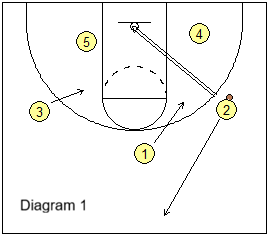
College coaches are stressing more offensive rebounding. Coach Brad Underwood's (Illinois) team shoots a lot of 3's and his rule is the 3-point shooter is the first to get back on defense, while the other four go for the rebound. Diagram 1 shows O2 taking the shot, and he sprints back. The other two perimeter players (O1 and O3) get to the wing-elbow areas on each side to help secure long rebounds that go over the bigs boxing out inside.
Important points about rebounding missed 3-point shots:
A missed shot from a wing or corner - 70% go long to the opposite side.
3-point misses often produce long rebounds over the heads of the bigs positioned inside.
Coach's Clipboard Premium Membership - join today! Immediate online access, comprehensive downloadable playbook included with offenses, defenses, plays, drills, coaching and player tips, animated diagrams, video clips, mobile-ready, pdfs for print-outs, and more!
Coaches... get a group membership (deeply discounted) for all your coaches!
For a new featured article every day - follow:
Email: hostmaster@coachesclipboard.net
Coach's Clipboard, US copyright, 2026, James A. Gels
Coach's Clipboard, Box 126, Charlevoix, MI 49720