From the Coach's Clipboard Basketball Playbook
Offensive rebounding and transition defense are seemingly often at odds, as prioritizing one can compromise the other. Teams must balance the desire for extra possessions with offensive rebounds versus the need to get back and prevent easy baskets in transition. So it's an interesting discussion with differing viewpoints.
If you watch the pros, most teams stress getting back on defense more than offensive rebounding. It's because their opponents have very talented, fast players who can handle the ball, attack and shoot the 3 with a high percentage.
At the high school and youth levels, your opponents may not fast break at all. Or if they do, will not be as skilled and as fast as elite players, and may have only one or two players who are good outside shooters. And many cannot finish consistently at the hoop off a fast speed dribble or quick pass. Thus, they are less of a transition threat. So you can make a case for more offensive rebounding at the high school and lower levels.
Which is best for my team?
There are trade-offs either way. More offensive rebounding emphasis results in more possessions, but gives up more transition baskets. Emphasizing transition defense and getting back quickly improves your defensive success but may decrease your offensive rebounding (and extra possessions), by more than 50% (in some studies).In our transition defense article, we reviewed how many coaches would traditionally drop their point guard back when a shot goes up, or maybe even drop two guards back, and if the point guard dribble-penetrates, the shooting guard drops back. But a recent poll of high school coaches now shows that over 50% will send three or four players to the glass for the offensive rebound, with just one player back.
Know your own strengths and style of play. If you have a couple big, slow post players, and you like to pound the ball inside on offense, then keep a guard or two back and let the bigs do the rebounding. If you have a smaller, quicker team, or use an offense where your post player is at the high post or arc (5-out), you might favor four players attacking the glass, using an offensive rebounding scheme (see below).
The game situation is also important: factors such as the score, time remaining, and the opponent's strengths can influence the decision to prioritize one strategy over the other.
Offensive Rebounding
See Offensive Rebounding for details and learn about the "spin move" and the "swim move" for gaining inside position.College coaches, such as coach Brad Underwood at Univ of Illinois, are stressing more offensive rebounding. His team shoots a lot of 3's and his rule is the 3-point shooter is the first to get back on defense, while the other four go for the rebound. Diagram 1 shows O2 taking the shot, and he sprints back. The other two perimeter players (O1 and O3) get to the wing-elbow areas on each side to help secure long rebounds that go over the bigs boxing out inside.
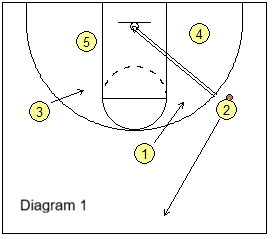
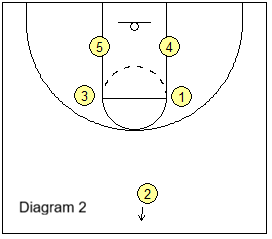
Important points about rebounding missed 3-point shots:
- A missed shot from a wing or corner - 70% go long to the opposite side.
- 3-point misses often produce long rebounds over the heads of the bigs positioned inside.
Offensive "Tagging" and transition defense
Some coaches use "tagging" as an offensive rebounding - transition defense strategy. When the shot goes up, send four or all five players for the offensive rebound by having each player "tag" or match-up with player who is guarding him/her. Make contact with a bump from behind, but no pushing and keep your hands off his back.This is almost the opposite of what we have always taught about fighting for inside position for rebounding. For offensive rebounding, get to your opponent's "high side" (side nearer half-court) for a chance for the rebound, or tip, while still being in a better position to impede transition.
Each player should get to the high (middle) side of his man... don't get caught on the baseline side. By being on the high side, you can impede your man's first few steps if they get the rebound, and essentially briefly pin him down.
Diagram 3 shows that our post players initially were inside, being fronted by the defense. When the shot goes up, they "hook" around their defenders to the high position. Diagram 4, shows the "50/50" high position. Our posts should not stay behind their defenders, but get shoulder to shoulder. This give us a better chance for the rebound, or a tip, while still being able to impede transition if they get the rebound.
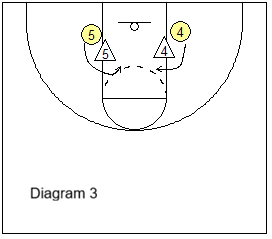
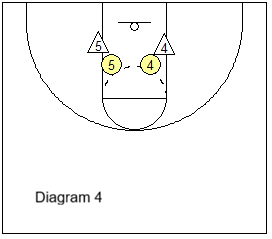
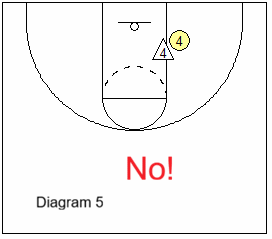
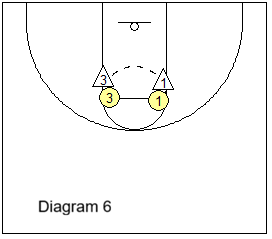
Diagram 5 shows the position we do NOT want to get caught in... low on the baseline side, as here O4 is already beaten in transition. Diagram 6 shows O1 and O3 tagging their men, in good position to impede transition, and yet contest for a long rebound.
Another 50/50 concept
If a player crashing for the offensive rebound believes he/she has a 50/50 chance of getting it, then go get it! Otherwise immediately sprint back on defense.Transitioning back
After the opponent gets the rebound, our tagging players immediately release from the contact and sprint back to a designated spot on defense.Designated transition roles
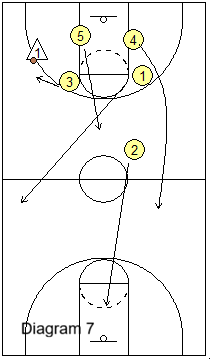
You may choose to do this differently, but here is one system for transitioning back. Each player is assigned one of these roles (diagram 7):- Ball stopper
This could be the wing rebounder on the ball-side (O3). He/she tries to slow or stop the ball after the outlet pass. - Middle stopper
This player gets to the middle of the floor and helps slow or stop the ball. This could be a big post player (O5), who will take up some space in the middle. - Sideline denier
This player denies the pass up the ball-side sideline, and may be the other wing rebounder (O1). - Weakside denier/helper
This player denies the skip pass to the opposite side up the court (O4). He/she also uses helpside principles and helps plug the middle. - Safety
This first player back (coach Underwood's shooter - O2) denies the long pass, and protects the basket.
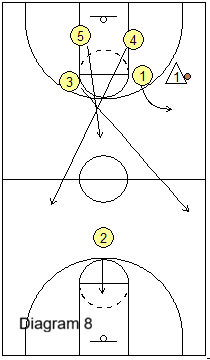
Finally, here is another way to transition and sprint back.
Related pages:
Want More Coaching Content?
Get access to more complete articles, diagrams, and coaching tools with Premium Membership.
View Membership Options


