From the Coach's Clipboard Basketball Playbook

Before reading this page, first see the page on "Transition Defense". Read the information on full court defense.
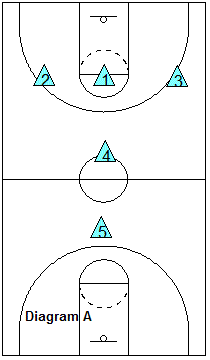
The 3-1-1 zone press features three defenders across the free throw line area, one just beyond the 3-point line in the center, and one down-court in "prevent" (see Diagram A). This press matches up well against teams that use a three-across, or 3-up, press offense.
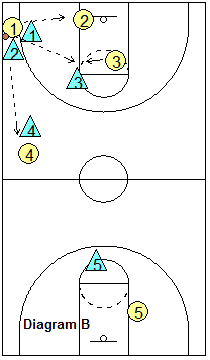
There are two ways of playing the inbounds pass. In the first method, the inbounds pass is not contested, but allowed to an offensive player near the corner (deny the middle pass). The middle and outside defender on the ball-side immediately trap the ball-handler, while the other three defenders cover the gaps, denying and looking to intercept the pass (see Diagram B).
Interceptors should watch the ball-handler's movements and eyes in order to anticipate where the pass will go. Once they see the commitment in the passer, they should quickly move into that passing lane and get the interception. X5 has the deep safety responsibility.
A second method has one of the three front line defenders guard the passer, and then stay with the passer after the inbounds pass has been made. This is to prevent the pass back to the offensive player who inbounded the ball. The other two front line defenders trap the ball, and the other two defenders play the gaps between the offensive players.
The defenders must stay ahead of (above) the ball. If the ball gets ahead of any defender, he/she must sprint back immediately to stay between the ball and the basket. If the press gets beaten, all defenders must sprint back to the paint and protect the basket. Once the break is stopped, they can fan out into their zone or man-to-man assignments.
Playing the gaps.
Diagram B. The two defenders not involved in the trap (X3 and X4), position themselves in the passing lanes, and look for the interception, while X5 is the deep safety. If the pass goes back to the inbounder O1, it's not a problem as X1 or X2 can recover to pressure O1.
3-2 Adjustment:
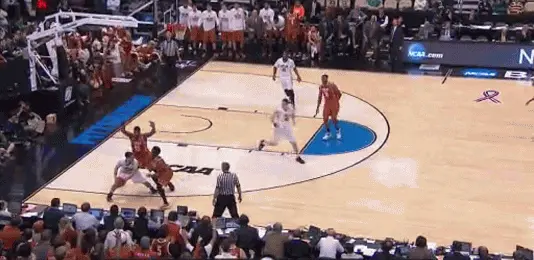
Diagram C. If the offense is successful in passing up the sidelines (on either side of X4), then adjust your zone defense to a 3-2 zone, bringing X5 up, and have X4 and X5 play just inside the mid-court area.
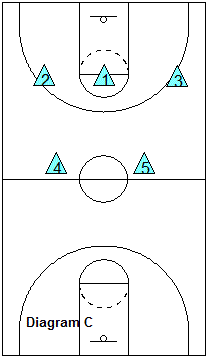
This of course is more of a gamble, because no defender is back in "prevent". The weakside mid-court player must have "back" responsibility in preventing the lay-up. For example, is the ball is being advanced up the offense's right side of the floor (X2 and X4 are defending on the ball-side), then X5 has the "back" responsibility.
All defenders must really hustle back any time the press is broken.
Want More Coaching Content?
Get access to more complete articles, diagrams, and coaching tools with Premium Membership.
View Membership Options


