

Basketball Plays - "Hi-Lo" Plays for the 3-Out Motion Offense
From the Coach’s Clipboard Basketball Playbook"Helping coaches coach better..."

In our 3-out, 2-in motion offense , we want our post players working together. Here are a few helpful hi-lo post actions. We start with simple post-post screening motion. We finish with "High-2" and "High-3" which work great against teams that full-front the low post. Also see the "Big Series" hi-lo plays.
Simple Hi-Lo Post Motion
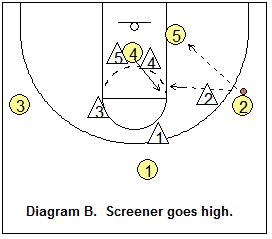
The ball-side post O4 screens for the weakside post O5 (diagram A). If O5 goes low around the screen to the block, then the screener O4 cuts up to the high post area (diagram B). The pass from the wing could go to either O4 or O5. If the pass goes to the high post O4, O4 either shoots or looks inside to O5.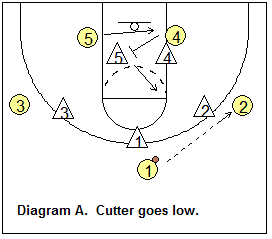
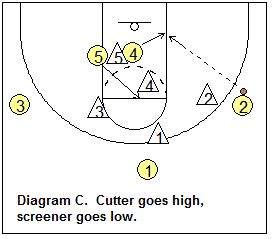
If the cutter O5 cuts to the high post (diagram C), the screener O4 seals and moves to the low block. The pass from the wing could go to either post player. The screener must read the situation correctly. The screener does the opposite of what the cutter does. If the cutter goes low, the screener goes high. If the cutter goes high, the screener goes low.
"41"
This is an effective, simple "hi-lo" play. O1 dribbles to the right wing (diagram A). O5 screens for O4, and O4 cuts out to the 3-point arc, along the opposite lane line. O2 and O3 move to the corners (for spacing). You now have a 4-out, 1-in look (diagram B).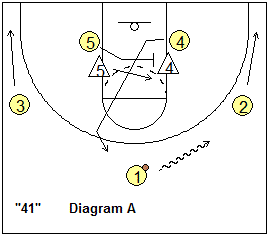
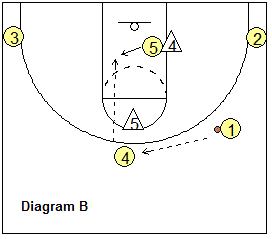
O1 passes to O4. Oftentimes, the low defenders switch the initial screen. O5 pins the X4 defender and posts up on the ball-side low post, looking for the pass from O4. This is a simple, effective play if you have a good low post player who can score 1-on-1.
"High-2" and "High-3"
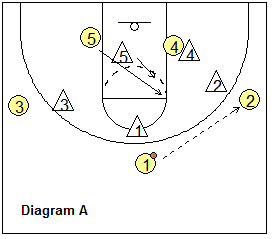
Here is another play that we run out of the 3-out, 2-in set. This play works well if you have a tall post player, and the defense fronts the low post.When the defense fronts our low post player O4 (diagram A), it is difficult to pass from the wing to the low post. A lob pass from the wing is not easy either because there is usually a helpside defender X5 in the paint. Instead of forcing the pass from the wing, call "High" and have the opposite post O5 cut to the ball-side elbow for the pass from O2.
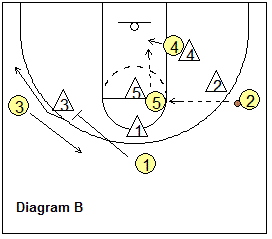
The X5 defender usually goes with O5, so now there is no helpside defender inside (diagram B). O4 seals the X4 low post defender outside, for a lob pass from O5. The pass from O5 to O4 usually has to be a lob over the defender. O4 holds the inside target hand up high for a good pass from O5.
Also notice that after passing to O2, O1 screens-away for O3. This makes the pass to the high post easier as O1 takes the X1 defender to the opposite side. Also the exchange between O1 and O3 keeps the X3 and X1 defenders occupied (and out of helpside). O1 goes to the weakside wing-corner area for a possible skip pass from O5, while O3 moves up to the top.
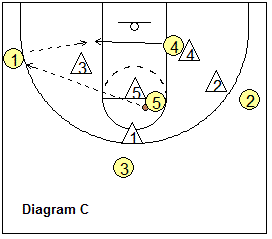
If the pass is skipped from the high post O5 to the corner O1 (diagram C), the low post player O4 seals the X4 low defender and then posts-up on the ball-side block for the pass from the corner.
We could run this play to either side. "High-2" goes to the right side (pass to O2), and "High-3" goes left (pass to O3). In "High-3", everything is just the opposite. The first pass goes to O3 while O4 flashes to left elbow and we are looking to pass to O5 inside. O1 screens for O2 and moves to the right wing-corner area while O2 comes to the top.
Share this page:


If you like this page, would you share it on your social media? Thanks! - Coach Gels
If you like this page, would you share it on your social media? Thanks! - Coach Gels
