From the Coach's Clipboard Basketball Playbook
There are many factors involved in becoming a good point guard. In addition to basic point guard skill fundamentals, there are factors such as how the coach wants to use his/her point guard, the style of play, the abilities and talents of the teammates surrounding the point guard, and the skills, temperament, experience and leadership qualities of the point guard him/herself.
The point guard is often thought of an extension of the coach on the floor, the "quarterback", or floor general. The point guard must have a good working relationship with the coach and be "coachable". He/she should know exactly what the coach expects of him/her, and what team strategies to use at a given time. The point guard must know his role on the team, whether he is expected to be a John Stockton type assist man, or a scorer like Allen Iverson.
This will depend not only on his own skills as a scorer, but also upon the talent of his teammates. If the team has some excellent scorers, he/she will want to be a good assist person and get the ball to those shooters. If no-one else on the team is a strong scoring threat, then the point guard may need to step up into that role.
See more comments...
Communication
A good point guard communicates with teammates both on and off the court. He/she learns to read the cuts and moves post players and wing players make. For example, you might work out hand signals so you know whether a wing player is cutting back-door or not.At times, you may see the your team bunched up with poor spacing, and you need to know how to back the ball out, directing them to move and correct their spacing. If you are playing with a shot clock, or near the end of a period, you must be aware of the clock and communicate to get the offense attacking at the right time.
A good point guard is always aware of the game situation, time-outs, fouls, clock, etc and communicates this to teammates.
Court Balance, Passing, Half-Court Offense
A good point guard must be an excellent passer and be able to get the ball to teammates for good shots. Some think that dribbling and ball-handling are the most important attributes for a good point guard, but I believe it is being an excellent passer and being able to find the open man - and knowing when to pass and not pass.Take care of the ball, and don't pass or dribble into a crowd. Avoid costly turnovers. Learn to open the passing lanes by "looking" the defender away, and using pass-fakes. Avoid passing in the direction you are looking, or "telegraphing" your passes. Look one way and pass opposite, using your peripheral vision.
Keep your head up and eyes forward toward the hoop at all times, and you should have all four teammates in your field of vision. Try to get the ball to your best shooters or to your teammate who may have a mismatch with his/her defender.
Keep your passing accurate and as simple as possible. Don't attempt some "fancy" pass when a simple chest or bounce pass will do the job. Keep your passes crisp with some zip, but not so hard that your teammates cannot catch the ball.
Distribute the ball from side to side using both sides of the court. There will be a natural tendency for a right-handed player to favor the right side of the court, but you must use the entire floor to overshift the defense and involve all your teammates.
Pass the ball into the high post (especially if you have a skilled high post player). A lot of good things can happen when the ball gets into the high post. Passing into the low post is usually easier from the wing position, but you can occasionally catch the defense sleeping.
To be a consistent winning team, you must be able to get the ball inside for those low post shots and lay-ups. You want to get to the free-throw line and get the opponent in foul trouble. Don't just rely on firing up three-pointers.
Avoid pointless dribbling on the perimeter. Keep the ball moving. Catch the ball in triple threat position and don't prematurely give up your dribble.
Look for your own shot too or otherwise the defense will not worry about defending you. Look for the outside shot, but also be able to beat your defender with a drive into the paint. When you penetrate, you cause problems for the defense if you can hit the little pull-up jumper just inside the arc in the paint, or if you can dish the ball to an open low post player.
Here's another example of communication. Usually the point guard has primary responsibility for being back on defense (when the shot goes up) and preventing the opponent's fast break. But when you dribble penetrate, you must have an understanding with either the #2 or #3 (wing) player that he/she will stay back out on top to prevent the fast break.
A little tip against zone defenses - realize that zone defense is most effective for the first 15 seconds. If you make a few quick passes, reverse the ball, and get the zone to move, it will often shift out of position. Then attack the gaps with either a good pass, or dribble penetration.
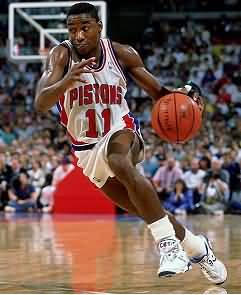
Isiah Thomas
Control the Tempo
A good point guard knows how to control the pace or tempo of the game. Is your team better as a fast-breaking team, or as a slow, deliberate team? This can change depending on which teammates are on the floor.If you have your big, slower guys in there, and if they are in foul trouble, and you have the lead, you might want slow things down for a few possessions. If you've got your speedy guards in there, pick up the pace.
If your team looks tired after a couple fast trips up and down the court, slow it down a little for a couple possessions. You can rest on offense, but never on defense. Momentum is a big factor too. If your team is "on a roll", keep things moving.
For teams that like to run, after the defensive rebound, get the outlet pass and quickly push the ball up the floor as fast as you can with either the dribble or a pass. Keep your eyes focused ahead and see the whole floor. This puts pressure on the defense, and you can get easy shots in transition, before the defense is set.
To quote Coach Wooden, "Be quick, but never hurry." You must always be in control - in control of the ball, your body, your emotions, and be in control of the game itself. Being in control with the ball and body means you have to be a good, strong, confident ball-handler and dribbler, and know how to jump-stop.
When pushing the fast break, if you realize the opponent has gotten back successfully and you don't have a "numbers advantage", abort the fast-break and dribble back out on top and start your half-court offense.
Hunt the Paint
A good point guard can attack the open seam in the defense and get into the paint for a lay-up, a jump-stop and pull-up jump-shot, a pass to a post player inside, or a kick-out pass to an open perimeter player. It's great if you can shoot the three-pointer, but getting into the paint is key when the game is on the line - you can get the higher percentage inside shot, or get fouled and go to the free-throw line. So you must be a good free-throw shooter too.In seeking the paint, expect and absorb contact. You're going to get bumped in there and you must be tough, take the contact and finish in spite of it. Like any other basketball skill, this takes some practice. Even in the paint, you must be in control - use a jump stop if the lay-up is not there, and a shot fake to get the defender in the air.
When attacking the paint, keep your eyes on the rim as this makes the defense guard you (making other teammates open), and gives you a better chance of finishing. Don't go in there every time, just to pass - be a threat to score.
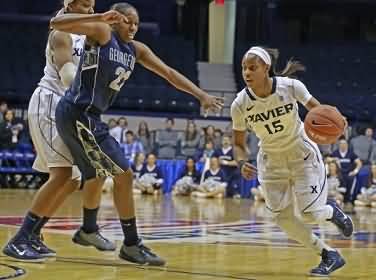
Attack with the dribble
Know the Game Situation
Know the game, score and clock situation. Read this page, the last several paragraphs, about strategies on how to end a quarter/half, and end of the game strategies: Game StrategiesDealing with Full-Court Pressure
When faced with a full-court press, you must be aggressive and "want" the inbounds pass. You are the team's best ball-handler and passer and their best chance for successfully getting the ball up the floor. Be confident and strong with the ball.Expect some contact and you might get to the free-throw line. Remember, it is not easy for the defense to steal the ball from you as long as you stay calm, stay out of the corners (where they can trap you), pass rather than trying to dribble through a double-team, and keep the ball in the middle of the floor or reverse it to the weak side.
In a full-court press, the defenders are mostly positioned on the ball-side of the floor, so a quick reversal to the opposite side will often beat it. Also, after passing off to another teammate, cut and try to get the next pass right back again. Often after the first or second pass is made, the press is beaten.
Leadership, Attitude
I like a point guard who is confident and a little "feisty" - who is able to grab his/her teammates and say, "C'mon, let's go!". Be pro-active and learn to anticipate game situations. It doesn't help to yell at a teammate after the defensive error has already been committed. Instead, anticipate that the opponent will probably go to their best shooter on the next possession and pro-actively tell his defender something like, "They're gonna go to your guy, John... be ready."Be the leader on the floor and the team will follow your example. Most often your offense starts with you, and you are the first line of defense when the opponent comes up the floor. If you meet their point guard in an aggressive manner on defense, your teammates with pick up on that and play hard too.
As a team leader, you must be willing to work harder than anyone else in practice so as to "lead by example". You must try to get along well with all your teammates and be a "peace-maker". Don't allow players to belittle each other (often done in a joking way, but still hurtful). Promote team spirit and unity. Make younger teammates and those teammates who get less playing time feel important too.
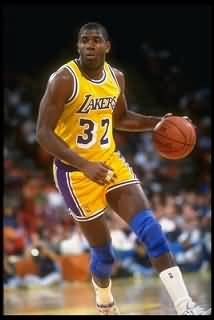
Ervin Magic Johnson
Skills Necessary to be a Great Point Guard
- Passing and faking skills
A good point guard must be clever and know how to pass-fake, shot-fake, fake with eyes and feet (jab steps), know how to change speeds, etc. You must also be an excellent passer (see Passing). Practice your "no-look" passes as much as your shooting. - Dribbling
You must be a good ball-handler, but you don't have to be the most awesome dribbler in the world. Magic Johnson was not the most awesome dribbler, but he could handle the ball very well, was very intelligent and an excellent passer, and one of the greatest players and greatest point guards ever to play the game.
You can be a very good point guard if you play under control, play smart, are able to dribble with either hand (with head and eyes forward), have a good crossover dribble, and an around-the-back dribble. See "Dribbling", "1-Ball Dribbling Drills" - 1-on-1 moves
Learn to beat your man off the dribble, take it into the paint and shoot the short jumper or dish off. Practice and get good at finishing lay-ups under pressure, in traffic. See Guard Moves and Skills. The "in and out" and the "hesitation" moves are good for attacking the defender in transition. - Outside shooting
It is another bonus if you can hit the outside shot too. See "Shooting Fundamentals, Form and Technique", "Shooting Drills" - Free-throw shooting
You will get fouled when attacking the paint, or late in the game when the opponent has to foul to stop the clock. So you must be a confident free-throw shooter. See "How to Become a Good Free-Throw Shooter". - Handling full-court pressure - beating the press
Have good court vision, see the floor, and see the defense. Make good decisions - when to attack with the dribble, when to pass. First get open and get the ball - get open for the outlet pass off a rebound, or for the inbounds pass after a score.
Attack with speed and quickness but always stay under control and avoid turnovers. Look up the court for a pass to an open teammate. Avoid traps and learn how to escape from traps. Show confidence and leadership. - Conditioning
You may have to play most of the game so be in excellent physical, aerobic condition. Get in shape before the season starts so you are ready to go on the first day. - Defense
A good point guard shows leadership on the defensive end and can "rally the troops" to tighten things up. Work on your on-ball defense, and your ability to stop dribble-penetration. You will also get ball-screened, so learn how defend the pick and roll. Defend without fouling. Play smart. We can't have our point guard sitting on the bench most of the game in foul trouble. - Intangibles
As discussed above: leadership, communication, court vision, time and game management, controlling tempo, decision making, etc.
Related page:
Want More Coaching Content?
Get access to more complete articles, diagrams, and coaching tools with Premium Membership.
View Membership Options

