
Basketball Fundamentals - Footwork
By Dr. James Gels, From the Coach’s Clipboard Basketball Playbook"Helping coaches coach better..."
Disclosure: This page contains affiliate links, which means that Coach's Clipboard receives a small commission (at no cost to you) if you make a purchase using these links.
Basketball is played on the fingertips and the balls of your feet. Everything you do involves correct footwork. Some players are naturally quicker than others. But a player's effective quickness can be greatly enhanced if he/she uses proper footwork. A naturally quick player who lacks good footwork skills can be beaten (or contained) by a player with sound footwork fundamentals. Watch Villanova men's team play... they have probably the best footwork of any team in the nation.
We often think of foot speed in basketball, but in reality it's more about starting and stopping and changing direction.
Offensive Stance
You always want to be in a good "basketball position" or stance. From this position, it is easier to start and stop, change direction and pace, jump, shoot, pass, catch and dribble. You should have your weight on the balls of your feet (the front part of the foot near the toes) and the feet should be shoulder width apart with the knees flexed.The head is centered above the lower body, and your hands are about chest high with your elbows bent and your arms close to your sides. When you have the ball on the perimeter, use the triple threat position so you are in a position to pass, shoot or dribble.
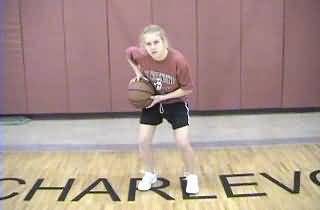
Pivoting
When you are stationary on the court, the rules say you can move one foot around, as long as the other foot (the "pivot foot") remains planted on the floor. This is called pivoting and all players must know how to pivot. There are two types of pivots, the forward pivot and the reverse pivot (or drop-step).Pivoting is done on the ball of the foot. You do not want to become flat-footed or have your weight back on your heels. The ball of the pivot foot must be in contact with the floor at all times and must not slide sideways. When you pivot, just actually spin around on the ball of your pivot foot.
If you pick up your pivot foot, or change your pivot foot to your other foot, you will be called for a traveling violation. When starting your dribble, the ball must leave your hand before you lift your pivot foot. When shooting a jump shot, you may jump and your pivot foot may lift off the floor, but you must release the ball from your hand before you land again on the floor.
In a forward pivot, the player pivots forward, while in a reverse pivot, the player pivots backward. For example, let's say the left foot is the pivot foot (usually the case for a right-handed player).
Here, a forward pivot would have the player pivoting (spinning), or stepping forward in a counterclockwise motion (if looking down from above). A reverse pivot would have the player pivoting, or stepping backwards (drop-stepping) in a clockwise motion. Just the opposite would be the case if the right foot were the pivot foot.
Which foot should be my pivot foot? Well, it could be either depending on the game situation. Outside, perimeter players most often will use their non-dominant foot as the pivot foot when facing the basket.
For example, a right-handed player facing the basket will most often plant the left foot as the pivot foot and make a jab step with his/her right foot (see Guard Moves and Skills), and just the opposite would be the case for the left-handed player.
Coaches vary on this, but we teach our perimeter players that if they are right-handed, the left foot should be the pivot foot, and lefties should use the right foot as the pivot foot. We believe this is simple and the most natural, athletic way for most players.
Post players must be adept at pivoting on either foot. A low-post player who has his/her back to the basket is often wise to receive the ball with both feet planted (as after a jump stop). This allows the player the option of selecting either foot for pivoting, depending on where the defender is located (for either a drop-step to baseline or a move to the lane -- see How to Become a Good Post Player).
You must be able to pivot forward and backward using either foot.
Pivoting drills
1. Start with the left foot as pivot foot. Pivot forward 15 times.2. Now backward pivot (reverse pivot) 15 times.
3. Switch pivot foot. Forward pivot 15 times.
4. Backward pivot (reverse pivot) 15 times.
Pivoting Pointers
1. You must keep your head up with eyes forward.2. Have your knees bent a little.
3. Your pivot point must not change.
4. Your pivot foot does not slide.
How to Stop
There are a few ways to stop - a one-two step landing, a stride-step, and the jump-stop.One-two step landing
When doing this landing (after a sprint or speed dribble), one foot lands first (the back foot) and then the second foot lands. The back foot becomes the pivot foot. When stopping, let the second foot to land extend wide from the back foot for better balance.Stride-step landing
See this video from Jeff Huber at breakthroughbasketball.com. Coach Huber says a stride-step stop results in better balance as the back foot acts as "the brakes". The feet should be wider than the hips, the inside shoulder faces the rim, and chin the ball with elbows out.Jump-stop
When doing the jump-stop, both feet land simultaneously. The last step should be a hop and when you land, have your weight leaning backward a little to help slow your momentum. Using this stop, you are now free to use either foot as your pivot foot. See: Basketball Fundamentals - the Jump Stop.There is confusion over the rules and what is legal and what constitutes a traveling violation. My interpretation is this... it depends on whether you already have possession of the ball or not (as in receiving a pass), and whether or not you have already used up the one-step that you are entitled to.
When receiving a pass with a jump-stop, you can pivot after the jump-stop and either foot can become the pivot foot. This is especially helpful for post players. A perimeter player can catch the ball with a jump-stop, and the pivot into triple-threat position if necessary and use the non-pivot foot for executing jab-step fakes or a drive step.
Now let's take a player who already has possession of the ball on the outside. He/she makes a dribble move into the lane, picks up the dribble, takes one step, and then lands a two-footed jump-stop.
So far, so good. But after landing the jump-stop, he/she cannot move either foot and has no pivot foot since the one step was already used up prior to the jump-stop. He/she could jump upward, but must either shoot or pass the ball before either foot touches the floor again.
1. A player who catches the ball with both feet on the floor may pivot, using either foot. When one foot is lifted, the other is the pivot foot.
2. A player who catches the ball while moving or dribbling may stop and establish a pivot foot as follows:
(2) On one foot followed by the other, the first foot to touch is the pivot.
(3) On one foot, the player may jump off that foot and simultaneously land on both. Neither foot can be a pivot in this case.
b. If one foot is on the floor;
(2) The player may jump off that foot and simultaneously land on both. Neither foot can be a pivot in this case.
3. After coming to a stop and establishing a pivot foot:
b. If the player jumps, neither foot may be returned to the floor before the ball is released on a pass or try for goal;
c. The pivot foot may not be lifted, before the ball is released, to start a dribble.
4. After coming to a stop when neither foot can be a pivot:
b. Neither foot may be lifted, before the ball is released, to start a dribble."
See Jump-Stop Drill.
I have tried to combine several of these moves into one drill. See Footwork Drill.
Changing Direction and Speed
To change direction, plant the opposite foot (the one opposite the way you want to cut), and then push off the inside part of that foot in the direction you want to go. For example, if you want to make a sudden cut to the left, plant the right foot and push off from the medial (inside) part of your right foot, changing your direction to the left. See: Lee Taft: Basketball Speed Starts with Stopping.Learn to change speed from a fast run, to a slow hesitation, and then accelerate to full speed again. See the "hesitation dribble" on the Dribbling page.
Jumping
Lot of players and coaches think that jumping is some skill that you are born with - either you have it or you don't. Well this is not entirely true. You can improve jumping ability considerably, otherwise our Olympic high-jumpers would never practice. Jump rope and run sprints to build your legs and agility. Practice trying to touch the net, or backboard, or rim every day. Do it from both a running start, and standing stationary under the basket.Practice jumping every day for 5-10 minutes:
Two-footed jump. Get under the basket and jump straight up and see how high you can get on the backboard or net. Bend at the knees and waist, weight forward a little on the balls of the feet.
Lower your hands alongside the outside of your knees. Then spring upward with simultaneous force from not only the thigh muscles, but you also can get a lot of lift from springing off with your feet and ankles... pushing off the tips of your toes (you can't jump flat-footed!).
At the same time your legs are working, your hands and arms are swinging up as high as possible. The upward force of the arms swinging may provide more lift, and you need to get them stretched as high as possible to get that rebound (or dunk). Do this jumping drill a number of times, until your legs get tired, and then try it again later.
One-footed jump. You can also do a jumping drill where you run in from the wing at a 45 degree angle and leap as high as you can and touch the backboard (or net). When you jump, just like doing a right-handed lay-up, you plant your left foot and go up with the right knee, pushing off the left toes. Be sure to go vertically, and not lose a lot of your elevation by going forward.
See: How to Improve Your Vertical
Faking and Cutting
Offensive moves (and some defensive ones too), often should be preceded, or "set up" by a good fake to get the defender to lean one way. This is true, whether you are making an offensive jab-step, or you are coming off a screen, or making a pass. Shot fakes and pass fakes are key fundamentals for all players.A little "mis-direction" move, like making a ball fake, shoulder or head fake, foot fake, or just an eye fake can open a lane for you to drive, cut, shoot or pass. Learn how to get open by making a front-cut, a V-cut, a back-cut, or a curl (see Cutting and Faking).
The jab step
Outside, perimeter players should learn the jab step (or drive step) as a fake to set up either the drive to the hoop, or to create spacing for the outside shot. This move is explained in detail on the Guard Moves and Skills page.The split-step
Some coaches that like the dribble-drive attack teach the split-step instead of triple-threat. With this, the player receiving the pass immediately starts a dribble-drive instead of getting into triple threat and pausing to read the defense.Defensive Footwork
Defense is played mainly with the feet. You must move your feet quickly to stay in front of the offensive player. You must use a correct defensive stance. You must know how to slide (sideways, forward and backward). You must know when to turn and sprint. You must know how to "close-out" on the offensive man and play good "on-ball" defense.Defensive Stance
Your weight should be on the balls of your feet (not your heels), and have your feet about shoulder width apart. Keep your knees bent and your back straight. Keep your head up, eyes forward, arms out with your palms up and elbows bent a little.Watch your opponent's belly-button. Your opponent can fake you with the eyes, a head bob, shoulder fake, a jab step, but the belly button is only going the way he/she is. See also Basic Man Defense and Defensive Tips.
Defensive Slides
When guarding your opponent, slide your feet sideways, using quick, short steps, and don't get your feet crossed. Don't hop. The key is "step and slide" (don't "slide and step"). Step with the foot on the side in the direction you want to move, and slide the opposite foot over.For example, if moving toward your right, step laterally with the right foot and then let the left foot slide over. When moving leftward, step sideways with the left foot and let the right foot slide over.
Don't "reach-in" and swipe at the ball, as this will cause you to lose your balance, allowing the defender to get around you. In addition, you may get the "reach-in" foul. If you get beaten in the open floor, don't just yell for help... turn and sprint after your opponent.
Once you get in front of him/her again, get back into your defensive stance.
Footfire and Slide drill
Have your players spread out, lined-up in two lines. Players are in a good defensive stance position. On "go", all players start the "footfire" with rapid moving of their feet up and down on the balls of their feet. After 10 seconds, call out "slide left" and the players slide several paces to the left.Then call "go" and they resume the stationary footfire. Have them move right, left, forward and backward using correct sliding and stance, and no crossing of the feet. Also see Z-Drill and Lane Slides.
Close-out on the ball receiver
Defenders must learn to "close-out" on the player with the ball. Once the offensive player receives the pass, the defender should rush toward the ball-handler in a low stance. The last several steps should be quick, choppy steps to stop your momentum (so the defender doesn't dribble around you).Your baseline line foot should be back in order to force the ball-handler toward the baseline. As you approach the ball-handler, snap your shoulders and head back to help slow yourself down.
Some coaches teach a one-hand high close-out, while some favor a two-hands high closeout. See the videos below and these pages:
Defensive Close-Outs and Drills
Lee Taft: Are We Teaching Closeouts The Best Way?
Related pages:
- The Jump Stop and Pivoting Drills
- Lee Taft: Basketball Speed Starts with Stopping
- Cutting and Faking
- Guard Moves and Skills - triple threat, jab-step, split-step
- How to Become a Good Post Player - and footwork
- Defensive Close-Outs and Drills
- Lee Taft: Are We Teaching Closeouts The Best Way?
- Footwork Drills
- Footwork Progression Drills
- Z-Drill and Lane Slides
- 1-on-1 Drills


