

Basketball Drills - Teaching the Match-up Full-Court Press - Breakdown Drills
By Dr. James Gels, From the Coach’s Clipboard Basketball Playbook"Helping coaches coach better..."
Disclosure: This page contains affiliate links, which means that Coach's Clipboard receives a small commission (at no cost to you) if you make a purchase using these links.
First see Match-Up Press Defense. Here we'll review the basic press rules.
Press Rules
- X4 plays the inbounder and tries to tip the inbounds pass.
- Try to force the inbounds pass to the corner.
- "Play someone" - basically matching up with every defender on a man. We may change from 1-Up, to 2-Up, to 3-Up, or 4-Up depending on how the offense is aligned.
- Always pressure the ball and try to force the ball-handler to speed dribble.
- If someone is speed dribbling toward you, sprint at her/him to trap. When this happens, teammates will rotate to give help and become "interceptors".
- X4 and X5 double-team the inbounds pass in the corner if the ball is even with or below the block.
- If the inbounds pass goes beyond the block, X5 pressures the ball forcing the speed-dribble, while X4 quickly sprints to get above the ball.
- If the ball is dribbled away from the sideline back toward the middle, X4 is in position to stop the ball-handler there.
- If the ball is dribbled up the sideline, it will eventually be trapped near half-court.
- If the offense passes the ball into the opposite corner (or the inbounder runs the baseline), use all the same rules, just on the opposite side.
- If the ball gets ahead of you, sprint back and try to "back-tip" the ball loose from the dribbler.
- Sprint back to the paint when you are beaten.
- When trapping, or trying to stop the dribbler, move your feet to get into position. Don't reach in and just swipe at the ball. Back-court fouls are usually "stupid" fouls, created when the opponent is in no position to score. It's especially stupid if the opponent is in the two-shot bonus, or if it is committed with only seconds remaining in a period.
This article shows how to teach the press using breakdown drills. First we start with 1-on-1, then 2-on-2, then progress to 3-on-3, 4-on-4 and finally the 5-on-5 match-up press. Generally, we use these break-down drills more often early in the season when we are first teaching our match-up press system.
Once our players get the general idea and understand all the press rules, we will mostly go 5-on-5 as the season progresses. Still, if problems arise, we will go back to these basic breakdown drills.
1-on-1 Drill
The defender makes the ball-handler speed dribble and tries to "cut" and contain the dribbler.Stay on your half of the floor as we run the drill on both sides of the floor and other players will be coming back the opposite side in the opposite direction. Use an assistant or a manager on the opposite end to make the inbounds pass.
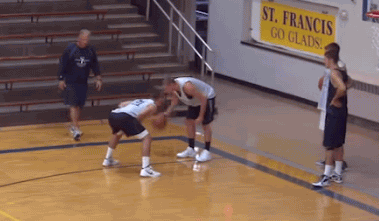
1-on-1 drill
2-on-2 Drill
See the diagrams below. Here we trap the corner with the ball passed in below (or even with) the block. We want our trappers knee-to-knee (so that the offense cannot split the trap), and we want our hands to be at the same height as the ball, without reaching-in.The ball will be passed out of the trap to the inbounder, who speed dribbles up the floor. The trappers try to tip this pass. In this drill we have a rule that the inbounder must receive the pass even with, or just a little above the trap. Our defenders now must sprint out of the double-team and try to catch or back-tip the dribbler.
This drill is important because oftentimes when the ball is passed out of a trap, the trappers just stand there and watch for a moment. We want them to immediately sprint out of the double-team and "stay-in the press". If our trappers pursue, sometimes they can "back-tip" the ball from the dribbler.
Stay on your half of the court as we will run another group back the opposite side.
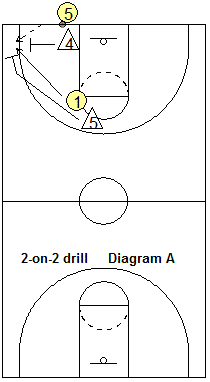
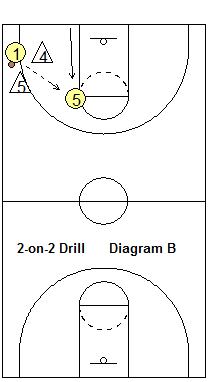
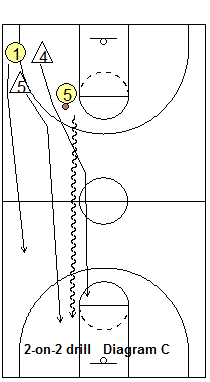
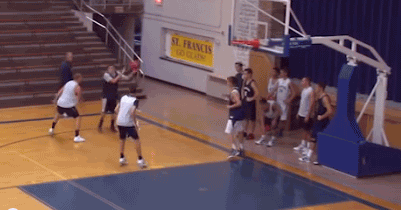
2-on-2 drill
2-on-2 Cut and Double Drill
See the diagrams below. Here we let the ball go inbounds in the corner. X5 will force O1 to speed-dribble up the sideline. O4 stays even with or a little above the ball. X5 sprints with O1, beats O1 to a spot along the sideline and "cuts" (stops) O1.This often occurs just beyond half-court, but could be anywhere along the sideline. As soon as X5 cuts O1, X4 sprints over and traps O1. Oftentimes O1 will give up the dribble and reverse pivot right into O4. In a game situation, X2 will be an interceptor of the pass out of the trap to the middle, and X1 will intercept the pass up the sideline.
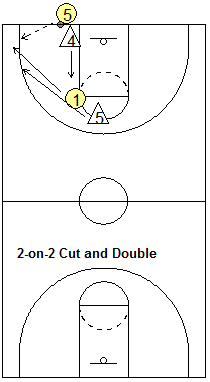
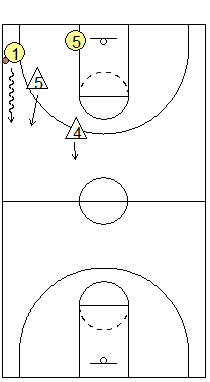
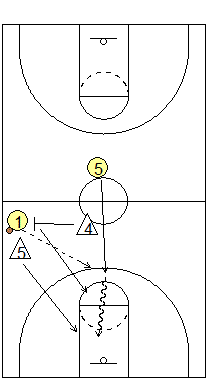
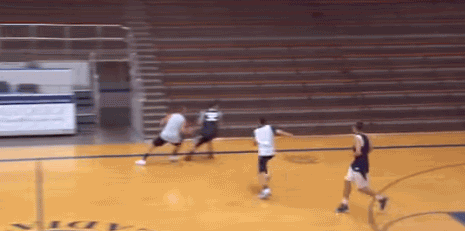
2-on-2 cut and double
2-on-2 Run and Jump Drill
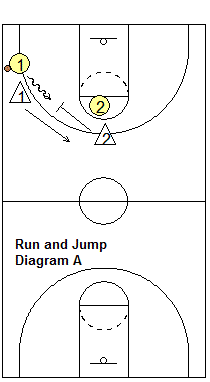
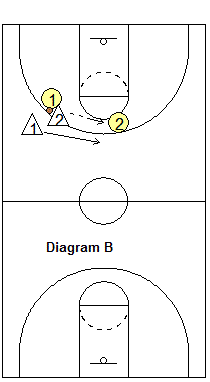
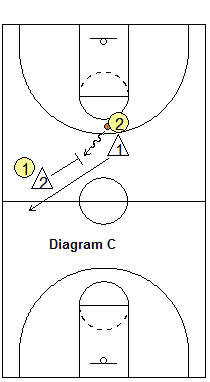
One of our press rules is to run at and double-team the ball anytime the ball is being speed-dribbled toward you. This could happen in the middle of the court, or along the sideline. Ordinarily, we only trap along the sidelines, not in the middle of the court. So, in the middle, it's usually a "run and jump".In diagram A below, O1 is speed-dribbling toward the middle, at X2. X2 sprints at O1 and contains the ball. O1 passes to O2 (diagram B), the defenders switch and X1 "jumps" to cut and contain O2, while X2 now has O1.
It is easier for X1 to jump to O2 because X1's momentum is going in that direction. It would be nearly impossible for X2 to turn around and sprint back to X2. So a "run and jump" is basically a defensive switch that occurs when the ball is being speed-dribbled at someone, and then passed. Now if O1 had stopped the dribble, we would have both X1 and X5 stay in the trap (a "run and double"), until the ball is passed out of the trap.
For the purpose of running the drill, O2 pauses a moment with the ball while O1 and X2 move up the floor a little. Then O2 dribbles at X2 (diagram C). X2 sprints at and contains O2, while X1 jumps to O1. And so it goes up the floor, doing usually three "run & jumps" before the offense tries to score.
3-on-3 Drill
X4 tries to tip the inbounds pass and does not trap the corner. Instead, X4 moves quickly above the ball (Diagram B) to (1) trap the dribble toward the middle (Diagram D) or (2) to become an interceptor of the pass to the middle. If X4 fails to get above the ball, O1 could easily dribble up the middle of the floor. Also, if the ball is passed back to the inbounder, X4 goes up and plays the ball.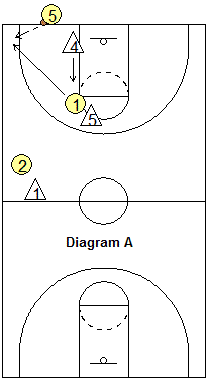
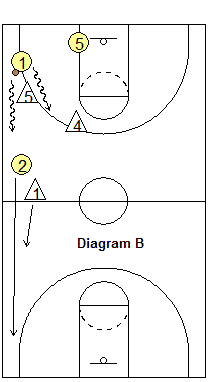
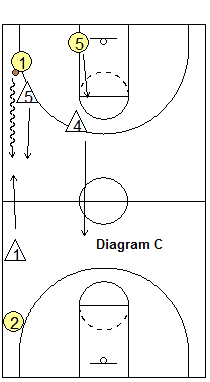
X5 tries to make O1 speed-dribble. X1 goes with his/her man (Diagram B), but if the ball comes up the sideline, will come back and "hit" the ball with a double-team (Diagram C).
In this drill, the offense will get the long pass for lay-ups, but this shouldn't happen when we are 5-on-5 and have our safety back.
Stay on your half of the court.
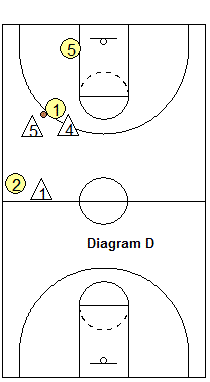
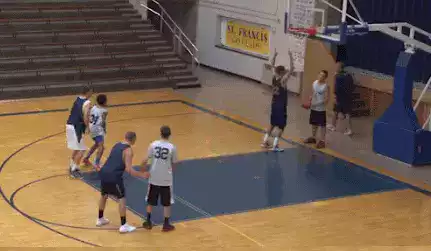
3-on-3 vs 2-Up
4-on-4 Drill
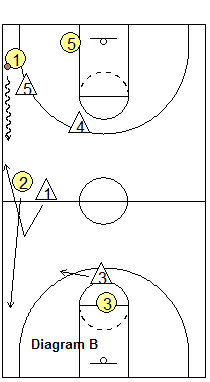
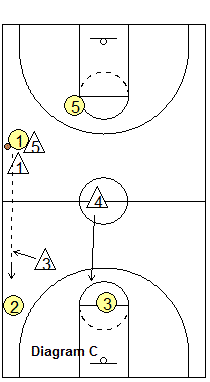
Now we use the entire court. This is the same drill as 3-on-3, except now our safety X3 rotates over to intercept the sideline pass. Again, we may give up the long pass and lay-up in this drill. But when we go 5-on-5, our weakside defender (X2) will sprint back as our safety to intercept that long pass (see the Match-Up Press Defense for details).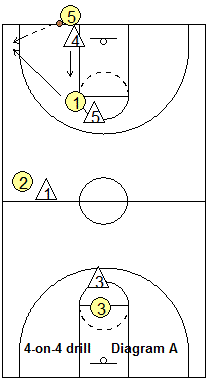
5-on-5 Drills
Now we work on our complete match-up press. We drill and match-up against various press offensive formations: 1-Up, 2-Up, 3-Up, and 4-Up. We also drill our "81" and "61" presses, which deny the inbounds pass.Depending on who our next opponent is, and what type of press offense they use, will determine which of these we are going to drill in practice. It's very helpful to know in advance what kind of press-breaker your opponent uses, because then you can drill against it and make adjustments.`
See the complete article in the members section.
Sign up now!
The complete article also includes:
- 5-on-5 Drills
- Deny the Inbounds Pass
- Switch and Deny on the Inbounds Screen
- Deny Diagonal Pass
- Defending the "Florida" Press-Break (diagonal cuts)
- Defending the Point-Guard "Clear-Out"
- Rotating for the Trap Beyond Half-Court
- Recovery in Transition Drills (3-on-2, 4-on-3, 5-on-4)
Related pages:


If you like this page, would you share it on your social media? Thanks! - Coach Gels
