


Basketball Defense - the Triangle Defense for Defending a Star Player
By Dr. James Gels, From the Coach’s Clipboard Basketball Playbook"Helping coaches coach better..."

This half-court defense is used mainly to stop a team with a dominant, star perimeter player. It is not the same thing as the "triangle-and-two" used to defend two good perimeter players.
This defense attempts to deny the star the ball, and double-team when he/she does get the ball. We try to make the star give up the ball, and then prevent him/her from getting it back. There is some gambling involved, especially if the opponent has another good outside shooter. But sometimes you have to "pick your poison" and decide who is going to beat you. If one of their other players steps up, you will have to adjust. Also see defending the star and other junk defenses.
Basic setup - the triangle
We use both man-to-man and zone principles. We assign our best perimeter defender to guard the star, and stay on him/her all the time everywhere, containing and denying. He/she will not come off the star to give help. If the defense uses two low post players, we will set up in a triangle (formed by X3, X4 and X5) as seen in diagram A. X3 is at the top half of the free-throw circle, our "point defender". X2 and X3 rotate in and out of the point position and help double-team the star.The star is the point guard
How we start the defense depends on whether the star player dribbles the ball across half-court, or receives a pass instead. In diagram A, X1 is assigned to the star. As the star dribbles across half court, X2 sprints up to double-team. Usually this causes the star to pass off to a wing. X3 takes the first pass out of the double-team and closes-out. X2 drops into the point position. X1 stays on the star and denies the pass back.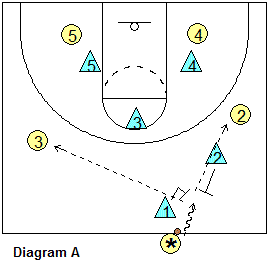
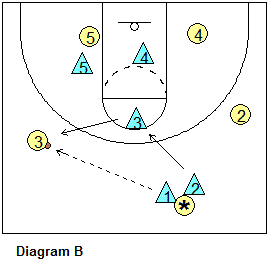
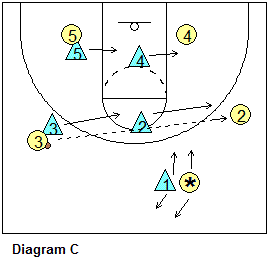
In diagram B, X3 takes the pass to O3 and X2 drops to the point. On the skip pass to the opposite wing (diagram C), X2 now takes the pass to O2, and X3 drops back to the point. X1 is always denying. Notice that our post defenders are using our basic man-to-man principles inside with the weakside post defender in helpside.
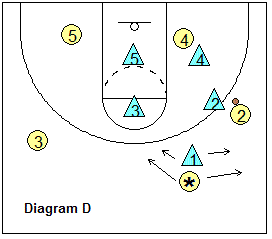
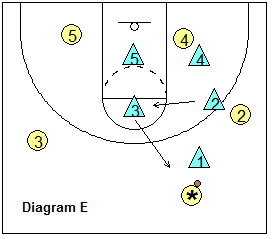
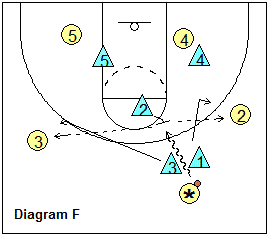
No matter how good your star defender is, the ball will get back to the star (diagram E). The point defender X3 sprints to double-team and X2 drops to the point. If the star is able to dribble out of the double-team and tries to penetrate (diagram F), our point defender is the next line of defense. In this case, the point defender X2 becomes the star defender (switches with X1), and X1 and X3 fan out to the other two wing players, who may be spotting up for a 3-point shot.
The star is a wing player
The star is a wing player, and not the primary ball-handler. The star does not dribble across half-court, but instead gets the pass to the wing. In diagram G, X2 is assigned to the star and tries to deny that pass. We do not double O1 as the ball comes across half-court.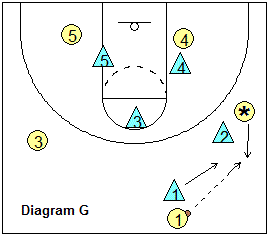
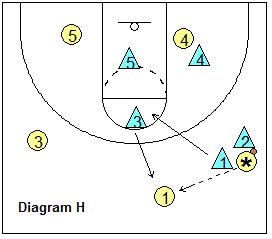
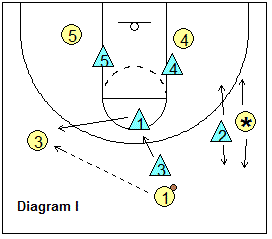
If the ball is passed to the star, X1 goes to double team (diagram H). The point defender X3 takes the next pass, and X1 drops to the point. X2 continues to deny the star. X1 and X3 move in and out of the point position as the ball moves.
The star tries to post up inside
The opponent may decide to try to post their star player inside on the block... (more in the members section)The star in the corner
The star has the ball in the corner. We won't necessarily try to trap here (although we could). If he/she dribbles baseline... (more in the members section)Denying basket cuts
If the star makes a cut through the paint... (more in the members section)Ball-screens
We jump-switch... (more in the members section)Boxing-out, rebounding
A true star player can beat you in many ways. Don't forget to box him/her out when the shot goes up... (more in the members section)See the complete article in the members section.
Sign up now!
The complete article also includes:
- The star tries to post up inside
- The star in the corner
- Denying basket cuts
- Ball-screens
- Boxing-out, rebounding
Final comments
This defense can help you defend a good perimeter player. It is a "gimmick" or junk defense and should not be used as your main defensive scheme. If another perimeter player starts making shots, you will have to adjust, or change to another defense.Related pages:
