
We like this offense a lot. We were formerly a motion offense team, but switched to the Read and React offense a few years ago. It basically is a motion offense, but with specific rules and "reads" for players without the ball. The player with the ball is free to do what he/she sees best... drive, shoot, or pass and cut. We get more player movement and less standing around with this offense. And we can still call set plays... but if the play fails, we just fall back into the Read and React as our basic offense... Coach Gels
General
- Similar to but different from motion offenses. In R&R, player with ball ("initiator") has options to do multiple things. The other four players ("reactors") read and react to what the guy with the ball does, and there is only one correct off-ball movement.
- Very flexible... can use with almost any set... 3-2, 4-1, 5-out, 1-4 high, etc. Can be used in an up-tempo, quick attack offense, and in transition, or in a deliberate, slow offense. You can use it as your delay offense without changing anything... just tell players "lay-ups only".
- Can be used against both man-to-man and zone defenses... so you don't need a separate zone offense.
- You can run plays, but use the R&R rules once the play breaks down or fails.
- Is a "system"... taught in 17 layers. Could start in 5th grade with layers 1 and 2, and add a layer every year as the kids progress. You can start it out with your varsity, teach first few layers and gradually add the layers as the weeks progress... makes you a better offensive team by tournament time. Varsity level players can progress through the layers more quickly given their skill level and maturity.
- Makes your defense better by having to guard the R&R every day in practice.
- Teach this offense by using R&R breakdown drills every practice, and 5-on-5.
Teaching Offense by Layers (17)
Start with layer #1 and progress. Each layer must be learned before the next is added and becomes a "habit" (automatic without having to think). Each layer is taught using breakdown drills.LEVEL A - Laying the Foundation
Layer #1, Dribble-penetration
Other 4 players use "circle movement" on the perimeter and rotate to fill the spots. The direction of the dribble-drive (right or left) determines the direction of the perimeter rotation. If ball penetrates right, the circle rotates right (counterclockwise). If the ball penetrates left, the circle rotates left (clockwise).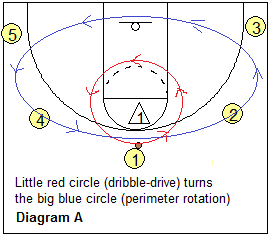
The only exception is dribble-penetration along the baseline (see below)... the opposite corner stays, so that the baseline dribbler has the option of passing out to the opposite corner.
Ball options:
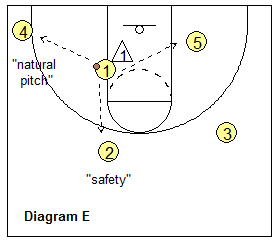
1. Dribble from the top... score, pitch out to corner-wing ("natural pitch") or back out to "safety valve" (back to the spot vacated by the dribbler), or dish inside. We always want to fill the spot where the penetrator started from, and this "safety" spot is often wide open.
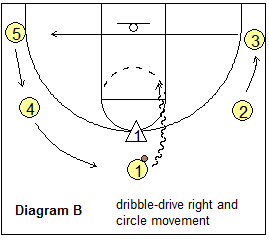
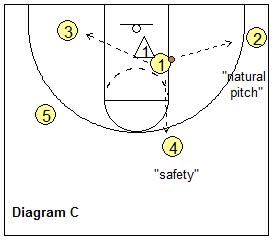
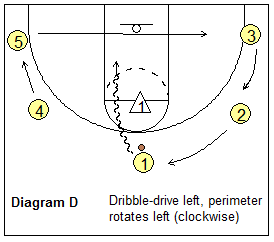
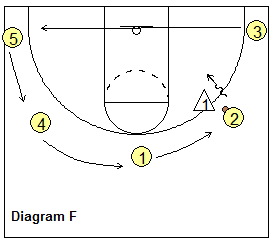
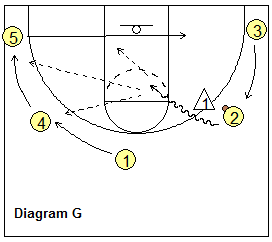
2. Wing dribble penetration... score, pitch out opposite, or dish inside.
Layer #2, Baseline dribble-drive
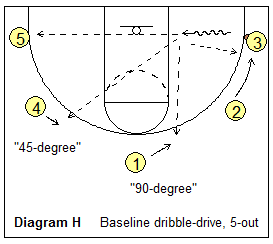
We always want the opposite corner filled for a kick-out pass. In our perimeter rotation with baseline dribble-penetration, we want these spots filled: the "safety", a "90-degree pitch", and a "45-degree pitch", in addition to filling the opposite corner.Offense in 4-out (diagram I):
Opposite wing moves to corner.
Post rotates up to 45 degree spot.
Opposite wing rotates to 90 degree spot.
Ball-side wing rotates to vacated corner (safety).
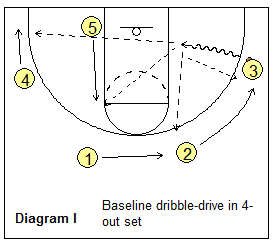
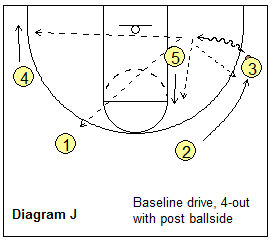
Diagram J shows the rotation when the post player is ballside. Here the post player I-cuts to the 90-degree spot, and the opposite top player (O1) stays put at the 45-degree spot, while O2 rotates to the safety spot.
Offense in 5-out (diagram H):
Opposite corner stays.
Opposite wing rotates to 45 degree spot.
Point rotates to 90 degree spot.
Ball-side wing rotates to vacated corner (safety).
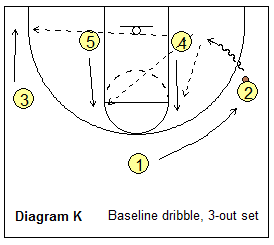
Offense in 3out-2in (diagram K):
Opposite wing slides down to opposite corner.
Both posts rotate up to 45 degree and 90 degree spots.
Point rotates to vacated wing-corner (safety).
Layer #3, Pass & Cut layer
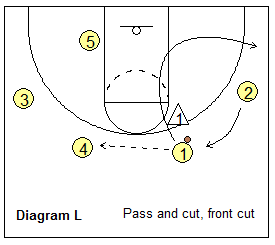
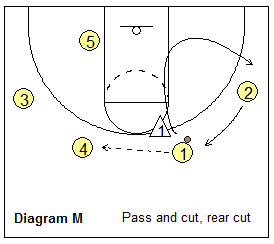
Rules...1. Passer... after passing, always basket-cut on a pass 1-spot away. Generally, we want these cuts all the way to the hoop before filling out to the perimeter. On a perimeter pass this would be either a front cut (diagram L), or a rear-cut if defender overplaying (diagram M). This cut eliminates the hedge defender once the ball is passed to the next spot. If the pass is made into the post (also just one spot away), then there will be either a Laker low cut, a Laker high cut, or a slide to the corner, or an "X-cut" (see Layer 12 below).
Note that the passer does NOT cut on a skip pass (two spots away).
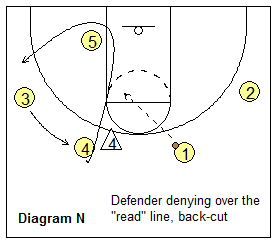
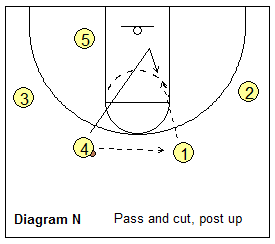
2. Pass receivers... if defender has a foot beyond the 3-point arc (aggressively denying pass), back-cut (diagram N). We call this "one foot over the read line" => back-cut. The next perimeter player over will naturally rotate into this vacated spot and is usually open.
3. After the cut, open spots are filled from the baseline up, and the basket-cutter fills the open corner spot.
Cutting Options...
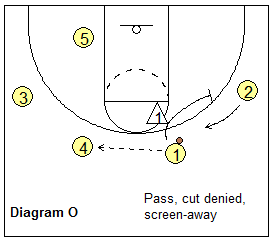
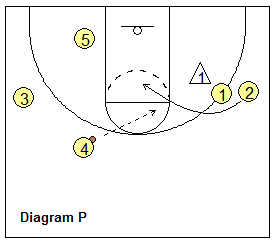
After passing, a cutter may be "stood up" by the defender who impedes and prevents his cut. Instead of fighting the defender, we use coach Bob Knight's "corner" principle... the cutter just simply moves sideways and screens-away (diagrams O and P).
A perimeter player may wish to post up his defender inside (if he is a natural post player, or if he has a size mis-match, or if his defender is in foul trouble). Diagram N shows O4 passing, cutting inside and then "shaping up to the ball", or posting up.
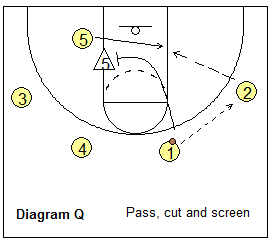
A perimeter player may pass and cut and then screen for a post player inside before filling back out to the perimeter (diagram Q). We also call this "chipping" or "bumping" the post defender. So "pass and cut" becomes "pass, cut, and screen". A perimeter player could also pass, cut and back-screen for another perimeter player (see Layer 8 below).
Layer #4, Post-player adjustment to dribble-penetration
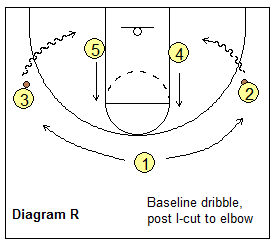
Rules...1. If dribble comes from baseline, post slides up to elbow (diagram R).
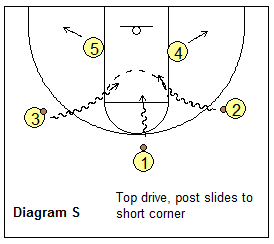
2. If dribble comes from the top, post moves to short corner (diagram S).
3. Rules 1 and 2 apply whether post if ball-side or weak-side.
Layer #5, East-West (lateral) dribbles
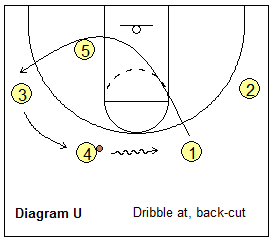
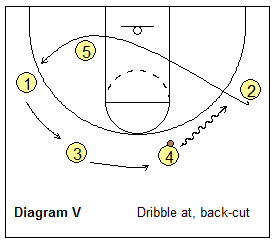
Three types of East-West dribbles... speed dribble, power dribble, circle reverse dribbleDribble At, Back-cut (Lateral Speed Dribble) Rule...
1. If someone is speed-dribbling at you, back-cut to hoop (diagrams U and V). Circle movement rules apply as before.
LEVEL B - Completing the Foundation
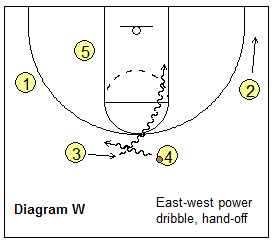
Layer #6, East-West Power (hand-off) dribble
1. Power dribble stance... dribbler turns back to basket and shuffle dribbles sideways... this has to look different than a lateral speed dribble. Player being dribbled-at V-cuts and then comes over for hand-off (diagram W), and you can run a pick and roll.2. Uses:
a. A pressure-release move.
b. A way that a post player on perimeter can get rid of ball, can pick and roll, and can get into the post. Can create mis-matches.
c. This is a way from going 5-out to 4-out to 3-out. Once post player cuts inside off the screen, he can either move out to open spot on the perimeter, or he can stay inside and post up.
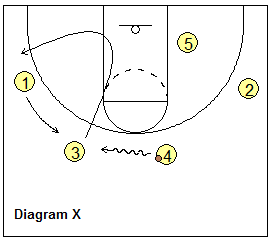
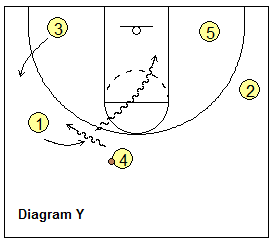
3. If teammate fails to read the power dribble and back-cuts through (diagram X), the dribbler can keep power-dribbling to the next perimeter player (diagram Y), or reverse and dribble back to the next teammate.
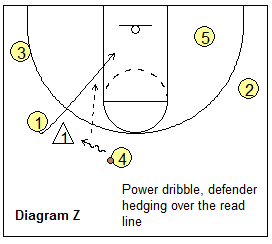
4. If the defender (X1) of our "hand-off receiver" (O1 in diagram Z) is over the read line and denying the hand-off, O1 simply back-cuts for a quick pass inside.
Layer #7, East-West Circle-Reverse Dribble
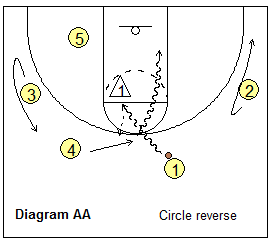
1. This is a response to a failed dribble-penetration. The next player, circles back for a pitch back on the perimeter, and the other players reverse their circle movement as well. This pitch back is similar to that used in the dribble-drive motion offense.2. The player receiving the pitch-back could shoot the 3, or dribble-drive to the hoop.
Layer #8, Back-screens
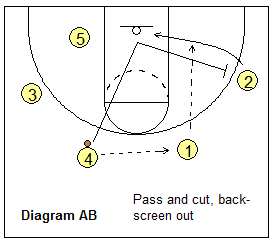
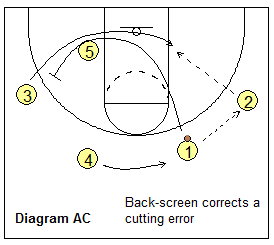
1. After any basket-cut, you can back-screen back out, and then pop out and spot up (diagram AB).2. Back-screens are useful in correcting rotation errors... if a player circle rotates incorrectly to wrong side, he can correct his error by just back-screening then popping out (diagram AC). Here, O1 should have cut to the right corner, but instead goes left and back-screens for O3. The good thing here is that O3 receives a double-staggered screen (from O1 and O5), and could be open for the pass from O2.
3. You can also back-screen for the ball (ball-screen) and pick and roll.
4. Back-screener should call out the screened player's name.
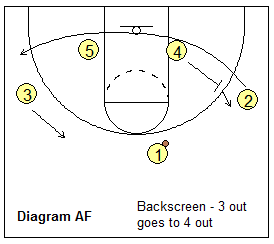
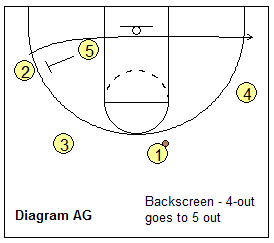
5. By using back-screens, your offense can go from 3-out to 4-out (diagram AF), and from 4-out to 5-out (diagram AG) in the same possession.
Layer #9, Multiple-staggered screens
This often happens accidentally when two players basket-cut at the same time creating traffic, or if one is coming off a back-screen. It's OK... just make sure players complete their cuts and you will get multiple screens from the "chaos".If in 4-out, a back-screen often results in two staggered screens (diagram AC above).
Tip: is you want a double-staggered screen, just go 4-out and have a wing player cut thru and back-screen out.
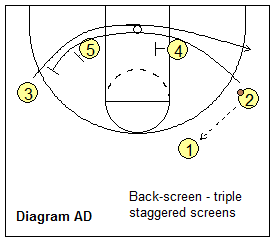
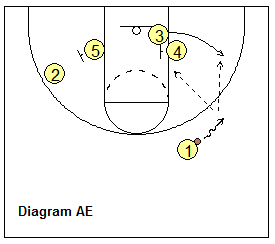
If in 3-out, a back-screen often results in three staggered screens (diagrams AD and AE)... example: a perimeter wing player basket-cuts goes thru to the opposite side and back-screens for the opposite wing. That wing will get three screens when he cuts thru and out to opposite wing (back-screener and two low post screens).
Tip: is you want a triple-staggered screen, just go 3-out and have a wing player cut thru and back-screen out. The back-screen and two posts create the triple-screen.
LEVEL C - Post Play
Review Layer #4 rules regarding dribble-penetration... baseline drive --> post slides up to elbow; dribble from the top --> post slides to short corner.
Layer #10, Advanced Post Player Reactions
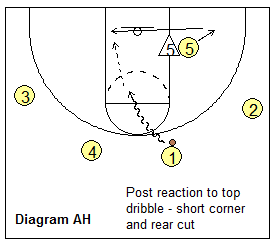
When sliding to short corner (on top dribble-penetration), if the defender goes with post player, post player rear-cuts underneath to opposite block for pass (diagram AH). If doesn't get the pass, he can circle move out and fill the opposite wing.Or, if a wing player drives into the top seam, once the post player is in the short corner, he can circle out and become the safety valve on the wing. For example, in diagram AH, if O2 had the ball on the wing and drives toward the elbow, O5 could rotate out to the spot vacated by O2 (safety).
Layer #11, 4-Out, 1-in Post Blocking
Post back-screens for a perimeter and then "shapes-up" and posts inside for the ball (diagram T). Post player might be relegated to just one side of the floor and screen for everyone who cuts through.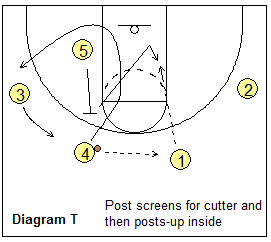
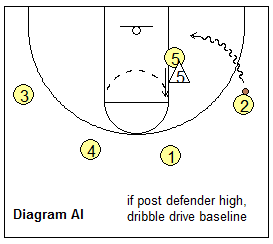
If ball is on the wing and post player is defended from the top, then dribble-drive baseline as post slides up to elbow (diagram AI). Here O5 can actually "block" or screen X5 from giving help on the dribble-drive.
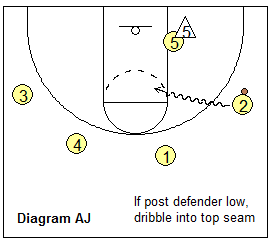
If ball is on the wing and post player is defender on baseline side, dribble-drive into the top seam as post player slides to the short corner (diagram AJ). Once again, O5 can "block" X5 from giving help on the dribble-drive.
Layer #12, 4-out, 1-in Post Passing
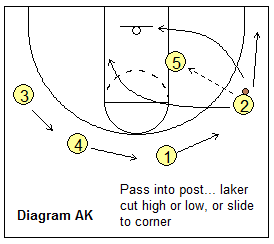
After a perimeter player passes into post, he can make one of 4 cuts:1. Laker cut baseline, below block (diagram AK)
2. Laker cut into top seam, above elbow (diagram AK)
3. Slide to corner (diagram AK)
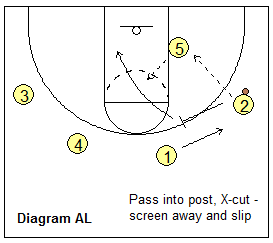
4. X-cut... passer moves up and screens for top guy, seals and X-cuts to hoop (diagram AL)
On all these cuts, the perimeter players still use the normal circle movement and fill the spots vacated by the cutter.
It doesn't matter is the pass into the post comes from the wing or the top, either way the passer has 4 cutting options (passer from top has the two Lakers cuts left and right, and left and right X-cuts).
Layer #13, 3-Out, 2-in Dribble-Penetration Game
Yes, you can dribble-penetrate and kick very nicely with two inside post players who follow the read and react rules.On baseline dribble, both post players slide up to elbows (and opposite wing fills opposite corner).
On top-seam dribble, both post players slide to the short corner.
LEVEL D - Icing on the Cake
Layer #14, Counter Help-side Defense - Pin and Skip Pass
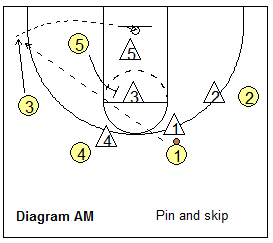
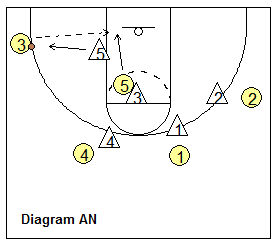
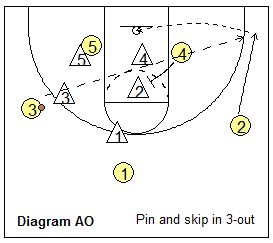
Weak-side post (or corner player) pin-screens the help-side defender farthest from his man... so usually your low man will back-screen (pin) the top help-side defender while his man slides to the corner for the skip pass and open shot. The pin-screener yells "Pin!" so the ball-handler knows to look for the skip pass.Three options for the pass receiver in the corner.
1. Shoot the outside shot (diagram AM)
2. Shot fake and dribble-drive
3. Feed the post player who just pin-screened for you (diagram AN).
You can use this to get from 5-out to 4-out, and from 4-out to 3-out in the same possession.
You can do this whether in 5-out, 4-out or 3-out. In 3-out, you have two natural pin-screeners with the two post players. Usually two back-to-back pin-screens will get someone open.
This concept works well against zone defenses too.
Layer #15, Attacking Zone Defenses
See this article: Notes on the Read and React Zone Offense. Use circle movement just like against man-to-man.Adjustments against zones:
- Pass and seam cut - use a button-hook cut (not basket cut) finding an open gap in the zone, delay there for two seconds, and then fill out to an open spot ("hook and look").
- Use the short corners as spots to fill. If the ball goes short corner, rotate as if it were a baseline drive... both corner spots should be filled as well as the 45 and 90 degree spots.
- Penetrate and pitch. Players rotate as normal and should be open on dribble-penetration.
- Safety valve is usually wide-open... just dribble in and pitch back to safety valve.
- Pin and skip pass works well against zones.
Layer #16, Seamless Transition from Fast-break to Half-Court Offense
Torbett runs the break different from us... he has cutters cut all the way through underneath and fill the opposite side. But we can still run our own numbered break as always and start with O1 dribble-penetrating. Just eliminate the 4-cut.Layer #17, Flowing from Set to Set
A perimeter player can move into post by:1. Pass and cut inside and post up.
2. Power (lateral) dribble and hand-off, and pick and roll inside.
3. Pin screen the help-side, seal and post up.
4. Can go 5-out => 4-out => 3-out.
A post player may move out to the perimeter by:
1. Back-screen for perimeter player (or ball) and pop outside to the 3-point arc.
2. Can go 3-out => 4-out => 5-out.


