Basketball IQ is often described as something a player either has or doesn't have. But much of basketball IQ can be taught.
While this article is part of the youth guide, much of this also applies to high school level coaches and players.
Young players become smarter basketball players when they learn what to look for, what it means, and how to react. Instead of simply memorizing plays and patterns, they begin to recognize situations and make good decisions on their own.
The goal is not to teach young players every possible basketball read. Start with a few important, repeatable decisions that occur in almost every game. As players improve, gradually introduce more advanced reads.
Basketball IQ isn't memorizing more plays. It's learning to recognize situations and make the right decision before the opportunity disappears.
On this page:
- Teaching Reads and Basketball Habits
- The 9 Basketball Reads That Matter
- Teaching Basketball IQ in Practice
- Progressing from Beginning to Advanced Players
- Letting Players Learn from Mistakes
Teach Players to Read, Not Just Run Plays
Plays and offensive systems are useful because they organize players and create opportunities. But eventually every play reaches a point where a player must make a decision.- The defender may deny the pass.
- Help defense may step into the lane.
- A teammate may cut.
- The defense may switch a screen.
- A driving lane may suddenly open.
This is where basketball IQ begins.
A simple teaching approach is:
See it → Recognize it → React to it
For younger players, turn complicated basketball concepts into simple if/then decisions.
- If your defender denies the pass, back-cut.
- If your defender backs away, square up and look to shoot.
- If you beat your defender and nobody helps, attack the basket.
- If help defense stops your drive, find the open teammate.
- If a teammate drives toward you, create space instead of crowding the ball.
From Reads to Basketball Habits
At first, young players have to think about these decisions. A player sees a defender denying the passing lane, remembers what the coach has taught, and then makes the back-cut.With repetition, that process becomes faster.
Eventually, the player sees the defender overplaying and simply cuts. There is very little conscious thought involved. The read and the response have become a basketball habit.
That is one of the goals of teaching basketball IQ. We want players to develop good habits so thoroughly ingrained that they can recognize common situations and react naturally.
Teach the read. Repeat the decision. Develop the habit.
The same read and react approach can be built into an offensive system. The Read and React Offense, for example, teaches players progressively through layers until the reads and reactions become habits.
This takes time, which is another reason youth coaches should emphasize learning and player development rather than wins and losses. Players will make mistakes while learning to read the game. A missed read, a late pass, or a poor decision can become a valuable teaching opportunity.
Allow players to work through that learning curve. Eventually they stop waiting for the coach to tell them what to do and begin solving basketball problems themselves.
They learn how to play the game — not just run plays.
1. Read Your Defender
The first defender a player should learn to read is the one guarding them (see Guard Moves).Before receiving the ball, players should notice:
- Is the defender denying the passing lane?
- Is the defender sagging toward the basket?
- Is the defender watching the ball instead of me?
- Is the defender leaning or overplaying one direction?
- Has the defender lost sight of me?
A defender who overplays the passing lane may be vulnerable to a back-cut. A defender who sags too far may give up an open shot. A defender who turns their head may lose a cutter.
Teach players that good offense is often a response to what the defender gives them.
2. Read the Driving Lane
Young players frequently decide to drive before looking at what is actually in front of them. Teach them to recognize space. Before attacking, ask:- Is there an open driving lane?
- Is a teammate occupying that space?
- Where is the help defense?
- Can I get to the basket under control?
- If the lane stays open — finish.
- If help defense commits — pass.
- If the defense closes the lane — stop under control (jump stop) and make another play.
3. Read the Help Defender
This may be one of the most valuable reads a young offensive player can learn.When a player penetrates, another defender often has to make a choice:
Stay with my player or stop the ball?
The offensive player should learn to recognize that decision.
If the help defender stays home, continue to the basket.
If the help defender commits to the ball, a teammate is probably open.
Instead of telling players simply to "drive and kick," teach them why the pass becomes available. The drive forces the defense to make a decision. Good offensive players see that decision.
4. Read the Closeout
When a player receives the ball on the perimeter, the approaching defender provides another important read.- A short, controlled closeout may take away the drive.
- A hard, long "flying-out" closeout may be vulnerable to a shot fake and drive.
- A defender who stays well back may give up the shot.
A useful progression is:
Catch → See the defender → Decide
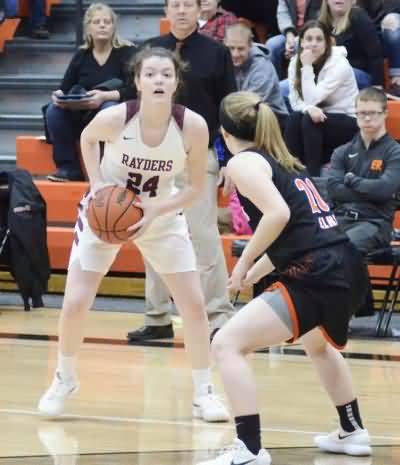
The decision might be to shoot, drive, pass (triple-threat position), or make a simple shot fake. The important part is that the decision comes from the defender's position.
Triple threat position
5. Read Screens
Screens create decisions for both the offense and defense (see Setting, Using and Reading Screens). Young players do not need to learn every possible screening read immediately. Start with the most obvious ones.For the cutter:
- Defender trails — curl toward the basket.
- Defender goes underneath — create space for the shot (fade or pop).
- Defender jumps the passing lane — back-cut.
- Defenders switch — recognize the new matchup.
- Defender helps on the cutter — roll or slip toward the basket.
- Defense collapses inside — look for space away from the basket (pop to arc).
- Defenders switch — seal the smaller defender when appropriate.
6. Read Your Teammates
Basketball IQ also means understanding what the other four offensive players are doing.Players should learn to recognize:
- When a teammate is cutting.
- When a teammate is driving.
- When a teammate needs space.
- When an open area of the floor needs to be filled.
- When two offensive players are occupying the same space.
Don't bring your defender to the ball.
When a teammate drives, young players often move toward the ball because they want a pass. Instead, they may need to stay spaced, drift to an open area, or cut behind a defender.
Good spacing makes good decisions easier.
7. Recognize an Advantage
Players should gradually learn to recognize when the offense has created an advantage.Common examples include:
- 2-on-1
- 3-on-2
- An open player ahead in transition
- A defender who has fallen behind the play
- A mismatch
- A defensive rotation that leaves someone open
Teach:
See the advantage → Attack the advantage → Make the simple play
The best decision is often a quick pass rather than a spectacular move.
8. Make Defensive Reads Too
Basketball IQ is not only an offensive skill. Defenders must constantly read the game.Teach players to see both the ball and their player whenever possible.
They should learn to recognize:
- When the ball-handler has been beaten.
- When help defense is needed.
- When they must recover to their own player.
- When another defender has helped and someone must rotate.
- When a pass is in the air and they can close out.
- When a teammate is screened.
- When the offense has numbers in transition.
"I moved because the ball was driven."
"I helped because my teammate was beaten."
"I recovered because the ball was passed out."
Those connections develop defensive basketball IQ.
9. Read the Game Situation
As players become older and more experienced, basketball IQ includes understanding the situation.Players should gradually become aware of:
- Score
- Time remaining
- Team fouls
- Personal fouls
- Possession situation
- Whether the team needs a quick score or a patient possession
- When to attack and when to protect the basketball
A shot that is perfectly acceptable early in a game may be a poor decision with a small lead and 20 seconds remaining. A rebounder may need to protect the ball rather than immediately throw an outlet pass. A defender may need to understand whether the team wants to foul or avoid fouling.
The point guard cannot make all of those decisions for everyone.
These lessons are difficult to teach only through drills. Coaches should discuss them during scrimmages and games.
Ask players:
"What did you see?"
Then:
"What were your options?"
This encourages players to think instead of simply waiting for the coach to tell them what they did wrong.
How to Teach Basketball IQ in Practice
Basketball IQ develops best when players have opportunities to make decisions. Avoid making every drill completely predetermined (see Planning Practices). Instead of always telling players exactly what move to make, occasionally give the defender choices and require the offensive player to react.For example:
- 1-on-1 Read Drill
The defender may deny or sag. The offensive player must recognize the defender's position and respond. - Drive-and-Help Drill
A help defender decides whether to commit to the drive. The ball-handler must finish if no help comes or pass when the defender commits. - Closeout Read Drill
The defender varies the closeout. The offensive player decides whether to shoot, drive, or move the ball. - 2-on-1 and 3-on-2 Games
These teach players to recognize defensive commitment, spacing, passing angles, and numerical advantage. - Small-Sided Games
Two-on-two and three-on-three basketball gives every player more touches and more decisions than traditional five-on-five play. Players repeatedly encounter cutting, spacing, screening, help defense, and passing decisions.
Ask Questions Instead of Always Giving Answers
One of the best ways to develop basketball IQ is to make players explain what they saw.Instead of immediately saying:
"You should have passed to the corner."
Ask:
"When you drove, who came over to stop you?"
Then:
"If that defender helped, who became open?"
This teaches the player how to recognize the same situation the next time it occurs.
Useful questions include:
- What did your defender do?
- Where was the help?
- What space was open?
- What did you see before you caught the ball?
- Why did you make that pass?
- What other option did you have?
- What could you do differently next time?
Don't Overload Young Players
A common coaching mistake is trying to teach too many reads at once. Young players do not need an encyclopedia of basketball decisions. Choose a few reads appropriate for their age and experience and reinforce them repeatedly. As those reads become habits, add new ones.Beginning Players
Focus on:- Defender denies → back-cut.
- Defender backs away → face the basket.
- Open lane → drive.
- Help comes → pass.
- Teammate drives → create space.
- See both your player and the ball on defense.
Developing Players
Add:- Closeout reads.
- Screening reads.
- Drive-and-kick decisions.
- Help-and-recover defense.
- Transition numbers.
- Basic game situations.
More Advanced Youth/High School Players
Add:- Defensive rotations.
- Switching and mismatches.
- Secondary screening actions.
- Reading multiple help defenders.
- Clock and score management.
- Creating and maintaining offensive advantages.
The objective is not to see how much basketball information a coach can give players. The objective is to help players recognize a situation quickly enough to use it.
Let Players Make Mistakes
Decision-making cannot develop if players are afraid to make decisions.If every mistake results in an immediate whistle, correction, or substitution, players may begin looking toward the coach instead of reading the game.
There are times when coaches need to stop practice and teach. But there are also times when players should be allowed to play through a situation, make a mistake, and discover what happens.
There will be a learning curve, particularly when players are first being asked to make decisions rather than simply follow instructions. That may occasionally cost a possession — or even a game.
For youth basketball, that is part of player development.
If winning today's game becomes more important than allowing players to learn, coaches may be tempted to control every possession, restrict players' decisions, or immediately punish mistakes. That may produce better short-term results while slowing the development of smarter, more confident basketball players.
Correct the read rather than simply criticizing the result.
A good decision can produce a missed shot.
A poor decision can occasionally produce a basket.
Teach the decision, not just the outcome.
The Goal: Players Who Can Solve Problems
Eventually, good basketball teams need players who can solve problems without the coach controlling every possession.- The defense changes.
- A play breaks down.
- A teammate gets trapped.
- The expected pass isn't available.
- A defender switches.
- Something unexpected happens.
And as those reads become habits, something even better happens. The coach gradually becomes less important during the possession. Instead of five players looking toward the bench for instructions, you have five basketball players seeing the floor, reading the defense, communicating with one another, and making decisions.
That should be one of our goals as youth coaches.
Start with simple reads. Repeat them often. Let players make mistakes. Ask them what they saw. Gradually introduce more difficult decisions as they become ready for them.
Teach the read. Repeat the decision. Develop the habit.
Ultimately, our job isn't merely to teach young players what to do.
It's to teach them how to play the game — not just plays.


