


Tips on Coaching Youth Basketball
By Dr. James Gels, From the Coach’s Clipboard Basketball Playbook"Helping coaches coach better..."
See: Coach's Clipboard Youth Basketball Membership for youth coaches and players.
Coaching Kids and Working with Parents
I have gotten lots of questions from coaches and parents about coaching youth basketball. Perhaps you are a parent coach, a teacher-coach, a former player, or someone who likes kids and wants to help coach kids. You may be organizing a recreational or church league, or are developing a program at your elementary school.Some of the kids may have played some, and some have never played before. Some are there because they already love basketball, and some are there because of their friends. Some were urged by their parents to give it a try.
Their parents will have varying perspectives. A few think you should win every game at whatever cost, and may yell advice from the bleachers. Some are thankful and happy that their child is on your team. Some are a little fearful that you may yell at their child, or that their child may not be a good player and will be embarrassed.
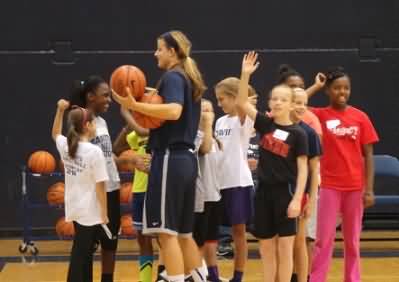
First, make it fun. Do not yell negative, embarrassing things at them. This is counter-productive, creating more stress and more mistakes. It makes you look like a bully, and you may completely turn the player away from ever wanting to play again.
You can yell, but only positive comments. If a player messes up, don't embarrass him/her in front of friends. For example, if someone is having difficulty with a certain skill or drill, rather than pointing the finger at him, blow the whistle and say, "Some of you are having trouble doing... blah, blah, blah... let me show you how to do this." Maintain a positive attitude, even if you are losing by 20 points.
Teach good sportsmanship by your example... no yelling at the refs, no demeaning the other team and players, etc. Teach them to play hard, but do not allow "dirty" play or trash talking. Teach them to respect their opponents and the officials. Wins and losses are not important at this age. Teach them that you don't have to win a trophy to be a winner.
Let the kids know that it is OK to make mistakes, that you expect them to make mistakes. Basketball is not a perfect game. All players make mistakes, even professionals. Coaches make mistakes, refs make mistakes. You just have to keep playing hard and learn from those mistakes. "A good garden may have a few weeds."
If you are coaching a team (not a large clinic-type group), teach them about teamwork and their responsibilities to the team... coming to practice, encouraging each other, helping each other, etc.
At the first practice, provide a handout for players and parents. This handout could contain some of the following items:- Your phone number, contact information.
- Game and practice schedules.
- Your goals for the team.
- A roster of all the players.
- Let them know about any costs.
- Your policy regarding playing time. I have actually seen parents in the stands timing each player's playing time with a stopwatch! All kids should play at this age, and winning is not the prime consideration. Having said that, I also think it is unfair for a player who frequently misses practices to expect as much playing time as kids who do come to practices. Explain your policy on excused and unexcused absences.
- You could mention how parents could help (some like to be involved), such as keeping stats, working the scoreboard, driving to games, providing treats, helping with uniforms, post-game pizza parties, and maybe even assisting in practice.
- Briefly discuss the all too common problem of unacceptable parent behavior at games... yelling advice to their own child, yelling at the refs and other team's players, and "coaching" from the stands.
When dealing with parents, be honest and open and show them that you really care about helping their child. Get them on your side. Make yourself available to talk with them after a game. Be diplomatic about any coaching advice they have to offer. Rather than arguing, just politely thank them for their interest.
Most parents are good people who care about their kids and just want what's best for them. Do not ignore parents. It is churlish, inconsiderate behavior. When coaching basketbal, parents can help make or break you. Believe it!
If you have a son/daughter on the team... be fair. Do not give your own child more playing time than the others. Treat your child like any other player on the team. Do not over-criticize and expect more, and don't provide any special treatment either. On the court, he/she is like any other player. Away from the court, he/she is your child and needs your love and support. Kids don't want to hear criticism or suggestions in the car on the way home. My daughter sure didn't!
From Coach Gels: there can be a fine line between (1) encouraging young kids to fight and compete, and (2) bullying and pushing them too hard (we've all seen those parents and coaches). It has to be done in a positive, encouraging manner... the art of coaching!
OK, let's play basketball! Let's put together a team.
Youth coaches usually have limited practice time. So don't try to accomplish too much. Keep things simple. Practices for young children should be no longer that 60 to 90 minutes because of their short attention span. So what are you going to teach them? What are your priorities? Others may disagree, but here are my thoughts.Teach fundamentals
Spend most of your time teaching fundamentals. At every practice, do ten minutes of ball-handling and dribbling drills. Do simple passing drills. Teach footwork (pivoting, triple threat position, doing lay-ups, how to shuffle and slide on defense, etc).Correct shooting form will be difficult to teach at very young ages, since it will an effort just to get the ball up to the hoop! But start working on correct form when the kids are strong enough, maybe 6th-7th grade. Teach man-to-man defense and how to box-out and rebound.
Team Offense
With a limited number of practices, find out who can dribble and handle the ball... they are your point guards and wings. Put them in a simple "3-out, 2-in" set (a point guard, left and right wings, and two post players), or bring one of the posts up to the free throw line... hence a 1-3-1 set.Or use a 4-out, 1-in set. I like Rick Torbett's "Read and React Offense" for teaching kids how to play. Just teach the first two or three "layers".
Teach them player numbering... 1 is the point guard, 2 is the right wing, 3 is the left wing, 4 is the right post, and 5 the left post. Using an offensive set is an attempt to maintain some spacing on the floor, so all five don't end up in the right corner!
But teach them that they must not stand still in their position, but cut and move. Don't teach plays other than a simple out-of-bounds play. Just let them "play".
I have a "first shot mentality" with kids this age. The player with the first open shot within his/her shooting range, should take the shot. This has several advantages. Too much passing at this age often results in a bad pass or a turnover, and you don't get a shot. So shoot early, and crash the offensive boards for second and third chances. It's a little like ice hockey at this age - the team with the most "shots on goal" usually wins.
First shot mentality also takes the pressure off the kids. Some kids are afraid to shoot, afraid to miss. Teach kids that you expect them to shoot when they are open, and that you don't expect them to make all their shots. Great shooters miss often. This helps them to be more relaxed.
So nothing fancy on offense... just a simple set, spacing, cutting, an early shot and crash the boards for more shots. If they are quick, fast break for easy lay-ups too.
Team Defense
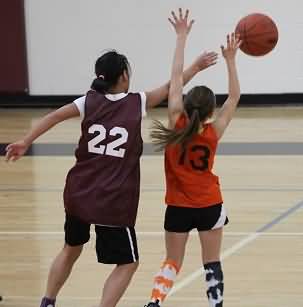
I believe all young players should learn to play man-to-man defense before learning zones. Teach good on-ball defense. As they get older, start teaching "deny" and "helpside" concepts (read "Basic Defense").Now having said this, you could probably win more games by using a 2-3 zone defense. At this age most baskets are made inside the paint. There is little outside scoring. So you pack the paint with a zone and you win. But winning should not be the prime goal at this age... it's learning fundamentals. Our town's recreational league does not permit zone defenses at the younger ages. Double-teaming is also not allowed, except in the paint.
They will become better defensive players if they learn to move their feet by playing good man defense. Even playing man-to-man you can clog the paint. I teach players that they must defend the paint since that's where most scoring occurs. Whenever there is an offensive player in the paint, a warning bell should ring in their heads that this player is a threat to score if he/she gets the ball. So deny this pass.
When an offensive player dribble penetrates, other defenders should collapse on him/her and "help". Also, when a player dribbles around the right corner (happens a lot), don't let him/her penetrate along the baseline. Stop the ball there and trap.
What about a full-court press?
Full court pressing probably should not be permitted with younger kids. But if you are permitted to full court press, use Ralph Miller's "man-to-man pressure defense". I have used this with middle school kids. It works great, and is easy to understand and teach.You will get steals and turnovers in the back-court that you can quickly convert into lay-ups. It is simply a full-court man-to-man defense, so it flows easily into your half-court man-to-man defense. To simplify, you pressure the ball handler, while the other defenders try to deny a pass to their man. Oftentimes, by just applying a little pressure, young inexperienced guards will make a turnover.
Don't let them dribble the ball uncontested up the floor. Apply a little harassment. Don't teach a lot of trapping and gambling. Everyone plays good man-to-man pressure. Now, this is important... if they see the ball advancing quickly up the court (a good dribbler, or a good pass), everyone sprints back to the paint to prevent the lay-up.
After stopping the lay-up, everyone can fan out and match up his/her man. So when you are beat on the press, you sprint back. If they don't sprint back, you will assume that they are tired and need a rest on the bench. When playing full-court defense, players will tire easier and will actually want rest, so this is good for getting all players in the game.
Substituting
You know who your best players are. When you substitute, always have two good players out there, someone who can dribble and get the ball down the floor, and someone who can rebound and play tough defense in the paint. I often have my assistant help with the substitutions, keeping track of playing time.You are too busy "coaching" to keep track of everyone's playing time. Before the game, discuss with your assistant who will be your starters, and your general substitution pattern (who plays what positions, etc).
With young players, let everyone have a chance to start at least one game during the season. I tell the kids, "its not who starts... it's who can finish the game". My players don't seem to care who starts because they know that they are all going to get to play. Sometimes a player will say, "Coach, let Jessica start this game, because I started the last one". Kids can be so great!
Running a youth clinic
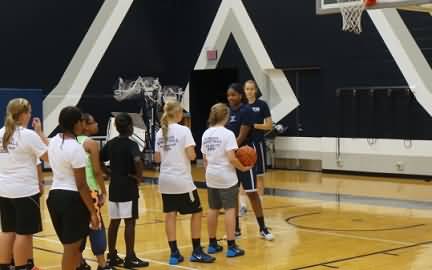
You and some other coaches/parents are organizing a general instructional clinic for elementary aged children... no actual set teams. What drills/skills are you going to teach? How can we make it fun?With youngsters, do about 90 minutes. Both girls and boys can participate. Teach individual player skills. Save team concepts, offensive sets, plays, zones, etc for their team coaches. You need to teach them correct fundamentals and make it fun for them.
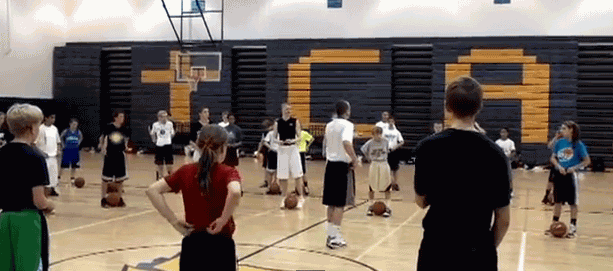
Spend 10-15 minutes on stationary ball-handling and dribbling drills. Get them all in one big circle, spread out, with the instructor in the center of the circle. Each player has a ball. The instructor goes through the ball-handling drills and dribbling drills and the players follow his example, doing the same drill the instructor is doing.
Since I am getting older, I often have one of our high school players do the ball-handling and dribbling demonstrations. They are heroes to the kids. Have a couple coaches walk around the circle helping kids who are having difficulty.
Then, spend five minutes on sideline dribbling drills.
A quick trip to the drinking fountain... then full-court dribble moves drill.
Play a couple quick games of dribble tag.
Do 5-10 minutes of two-man passing drills... the chest pass, bounce pass and overhead pass. Demonstrate correct technique. Step into the pass, hands on both sides of the ball, snap the pass finishing with the thumbs pointing down.
Work on lay-ups, demonstrating correct footwork. Split them into two groups (equal talent) with a group on each basket. Each group makes two lines (shooters and rebounders) along the sidelines. Start with right-handed lay-ups.When you say "go" each group starts doing lay-ups, with the shooters going to the end of the rebounding line and the rebounders going to the end of the shooting line. With each made basket, that group yells the count (the number they have made). First team to 10 wins. The losers do five push-ups.
You can have similar competitions shooting short shots in the paint area. Here's a variation the kids love... they are all on the same team. Have a shooting line starting in the center of the free throw line area, and a rebounding line near the basket. The rebounder will pass it to the first person in the shooting line, who steps in to about the hash marks (depending on the age) and shoots.
The kids yell out their number of baskets each time one is made. You give them a time limit and a goal of how many shots they must make in that time period (adjust this based on their skill level and so every player gets to shoot at least twice).
If you have a big group, do this on both ends of the floor. Make it challenging for them. If they fail to make the goal in the allotted time, they all have to do five push-ups. Now here's the part they love... if they succeed in "beating the clock", then all the coaches have to do five push-ups! They love standing over you counting your push-ups.
Use your imagination. Create other little games for them.
Spend the last 15-20 minutes scrimmaging using man-to-man defense, no full-court pressing. Divide the talent equally and mix them up so you don't have the same kids on the same team each week. When you have both girls and boys, I have found that it is best to split them up and have the girls scrimmage on one end and the boys on the other. When playing together, some boys will never pass to the girls and the girls get upset and frustrated. So if you have enough players, let the girls have their own game.
At the end of practice, get them all in the huddle, offer encouragement, and advise them to do dribbling and ball-handling every day at home for ten minutes. Then everybody puts there hands together and yells your school mascot name-- like "Rayders!!!"
Basketball coaching articles that may help
(don't try to do too much too soon):- Pre-season Middle School/Youth Practice Plan
- Footwork
- Ball-Handling
- Dribbling
- Basic Dribbling Drills
- Sideline Dribbling Drills
- Dribble Tag
- Half-Court Passing Drills
- Full-Court 2-Line Passing Drills
- Full-Court Weave Passing Drills
- Basic Defense
- Pressure Defense
- Transition Defense
- Defense 1 on 1 Drill
- Shell Drill
- Z-Drill and Lane Slides
- Defensive Tips
- Rebounding Tips, Techniques and Fundamentals
- 3-2 Motion Offense (keep it simple)
- 4-Out Motion Offense (keep it simple)
- 1-3-1 Motion #1
- 1-3-1 Motion #2
- 1-3-1 Motion #3
- Offensive Tips for Youth Players
- The Lay-up - Finishing at the Hoop
- Lay-up Drills
- Shooting Fundamentals, Form and Technique
- 2-Man Shooting Drills
- Setting and Using Screens
- Screen, Pick Drills
- Out-of-Bounds Spread play
- Pre-game
- Game coaching
Good luck! Have fun! Become a Coach's Clipboard Youth Basketball Member!
