From the Coach's Clipboard Basketball Playbook
Good defense requires more than knowing where to stand. Players must recognize what the offense is doing, communicate, and respond together.
Recognize the threat. Know your responsibility. Make the next defensive play.
This toolkit explains common defensive concepts, coverages, and the reads that make them work. Choose a few that fit your players, establish clear responsibilities, and practice them together.
The approaches described here are options, and some reflect our preferred teaching methods. Coaches may use different rules for positioning, helping, and defending screens. Players must recognize what the offense is doing and respond within their team's defensive rules, so all five defenders work together.
Coaching youth basketball? Start with containment, positioning, communication, help and recovery, and rebounding. Add more complex coverages as your players become ready.
1. Defensive Foundations
Most of this applies to man-to-man defense, with some related principles in zone defense.- Communication
This is one of the biggest keys in playing great defense. "If you're not talking, you're not playing defense." Defense is a team skill, so players must know what each other is doing, or should do. Calling out who has the ball-handler, calling out screens, cutters, Blitz, ice, defensive help, etc are just a few examples. - Close-outs
Definition: As the ball is passed to a perimeter player, the assigned defender sprints toward the receiver, then closes under control to contest the shot and contain the drive.
Read: Good shooter, close out tight with hands high. Poor shooter, can drop off a little to contain.
Tradeoff: too tight, can't contain the dribble; too soft, no pressure and might give up open shot.
See: Close-Outs and Drills - On-Ball Defense
Definition: Defender uses correct stance and footwork to pressure and contain the ball. For defenses that force baseline, the defender's inside hand is high and outside hand is low, while the inside foot is high and the outside foot is back.
Read: Player drives, move feet quickly to contain, don't reach in and swipe at the ball.
Teaching cue: "Move your feet". - Off-Ball Defensive Positioning
Definition: For teams that prefer "Deny" defense, one pass away from the ball, use ball-denial, deny position, to prevent pass.
For other teams, one pass away, defender is a step or two up the line and off the line, sagging a bit inside and toward the ball in order to give help (and recover) on dribble-penetration.
Two passes away from the ball, defender is in help-side position - pistols position - with one hand pointing (like a pistol) at the ball and the other hand pointing to your man.
Teaching cue: "ball-you-man".
Read: have one foot in the lane with ball on the opposite wing. Get to the middle of the lane with the ball in the opposite corner.
Tradeoff: Helping too far or too late can leave a shooter open. Helping too little can allow a layup. - Help and Recover - Dribble-Penetration
Definition: A defender moves toward a driving threat, then recovers to an assignment as the ball moves or the threat ends. The amount of help depends on your team's rules.
Read: Has the ball-handler beaten the on-ball defender, or can a brief show of help discourage the drive?
Reaction: Show help early. If the drive is contained, recover on the pass. If you must fully stop the ball, teammates must cover the next assignments.
Tradeoff: Helping too far or too late can leave a shooter open. Helping too little can allow a layup.
Teaching cue: "See your player and the ball. Help, then recover."
For on-ball/off-ball defense and help and recover, see Man-to-Man Pressure Defense - Trapping
Definition: Two defenders trap the ball trying to force a turnover. This could occur on the perimeter ("Red" and "Side-Fist") or in the back-court (press defense). You can also trap the low post.
Tradeoff: trapping is a gamble and you could give up a layup or easy shot.
2. Ball-Screen Coverages
There are several ways to defend ball-screens (see Defending Ball-Screens). Choose the coverage before the possession. Players read the action within that coverage and communicate any adjustments.Read: Is the screen being used, rejected, or slipped before contact?
- Switch
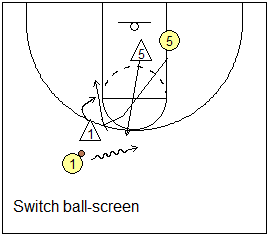
Definition: The two defenders exchange assignments when the offense uses a screen. On a called switch, the screener's defender takes the ball-handler. The original on-ball defender takes the screener and protects against the roll. Follow your team's rule for a slip or rejected screen. If your system calls for returning to the original matchups, switch back at the first safe opportunity, with communication.
Tradeoff: A switch can limit an immediate opening but create a size or speed mismatch.
Teaching cue: "Call it early. Exchange assignments. No free roll."
- Going Over or Under the Screen
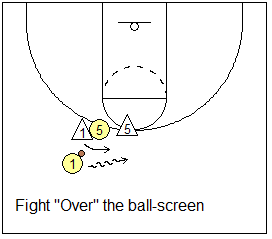
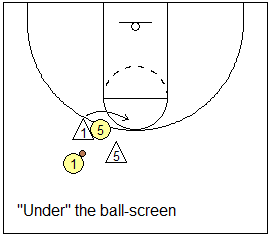
Going over and going under refer to the on-ball defender's movement/route.
Read: Good shooter, go over the screen. Poor shooter, go under the screen.
Going Over Definition: The defender fights over the screen to stay close to the ball-handler. This is useful against players who are strong shooters.
Tradeoffs: The immediate risk is that the ball-handler gains separation to shoot or drive. If the defender does not recover quickly, the screener may be left open for a shot or a roll to the basket.
Going Under Definition: The defender slides underneath the screen, creating space to contain penetration while conceding room for a perimeter shot. This is effective against ball-handlers who are less likely to shoot.
Tradeoffs: Might leave a skilled shooter open for three-point shot. Also allows the ball-handler to drive without immediate defensive pressure.
- Hedging
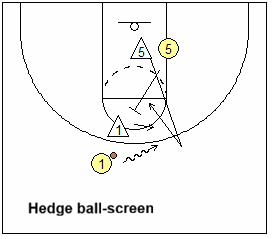
Definition: The defender guarding the screener (hedger) steps out to impede the ball-handler's progress as the screen is set. This disrupts the ball-handler's momentum and forces difficult decisions. The on-ball defender fights over the screen to stay with the ball-handler. The hedger recovers to the screener after the on-ball defender recovers.
Tradeoff: Could leave screener open for a roll to the basket or allow the ball-handler to split the hedge and attack the rim.
- Drop Coverage
Definition: The screener's defender stays below the screen, dropping toward the basket to contain the ball-handler and protect against the roller. The on-ball defender fights over the screen and recovers to the ball-handler. The goal is to protect the paint while contesting the shot from behind. Drop coverage can give players relatively clear responsibilities.
Tradeoffs: Can concede pull-up jump shots, including three-pointers if the defender drops too deep. Pick-and-pop action can leave the screener open unless the defense adjusts or rotates. The dropping defender must contain the drive without giving up an easy pass to the roller. - Blitz Defense
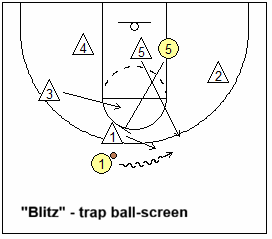
Definition: Both defenders trap the ball-handler.
Reaction: The on-ball defender applies immediate pressure. The screener's defender helps trap the ball-handler, creating a two-player trap.
Reads: when the on-ball defender hears the "Blitz" call, he fights over screen and maintains pressure. Help-side defenders must communicate and be prepared to rotate quickly to cover any gaps left by the Blitz.
Tradeoffs: The Blitz can leave the screener open on the roll if help-side defenders are slow to recover. If the double-team is broken, it risks giving up open shots to the roller or a kick-out pass to an open shooter.
- Ice Defense
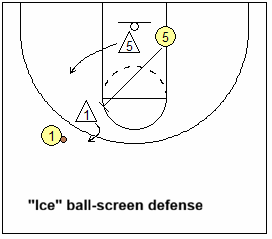
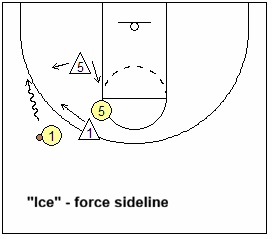
Definition: Forcing the ball-handler toward the baseline, preventing middle penetration. Only use for wing-side ball-screens, not middle ball-screens.
Reaction: The on-ball defender positions so as to force the ball-handler away from the screen. This limits scoring opportunities by pinning the offense to one side of the court. The on-ball defender must communicate the screen effectively. The screener's defender prioritizes containing the ball before recovering, getting help behind the play.
Tradeoffs: If defenders fail to communicate, it can lead to open driving lanes for the ball-handler and easy passes to the rolling big man.
3. Defending Off-Ball Actions
- Basket Cutters
Basket-cuts Definition: give and go cuts, wing cuts, flash high post cuts, back-cuts where the cutter cuts through the paint.
Reaction: Deny the pass to a cutter moving through the lane by keeping between your man and the ball.
Teaching cue: "bump the cutter". - Curl Cutters
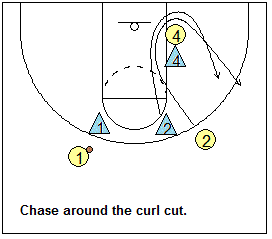
Curl-cut Definition: A player curls tightly around a screener toward the basket.
Reaction: Defender chases the offensive player around the screen as closely as possible.
Teaching cue: "chase the cutter".
Read: If your team's coverage allows switching, and if the chasing defender is trailing too far behind curl-cutter, the screener's defender should switch and take the cutter, and the trailing defender takes the screener.
Tradeoffs: If the defender trails too far behind the cutter, the cutter may curl to the basket and receive a pass for an open shot. If a switch is made, a size mismatch is likely to occur. If the defender goes under the screen instead of trailing, the cutter might fade to the corner for the pass and shot.
- Downscreens
Reaction: Same as defending curl-cuts. Defender chases the offensive player around the screen as closely as possible.
Reads: if it is a guard to guard down-screen, or post to post, you can switch this screen since a size mismatch is less likely. - Backscreens, Flare screens
Backscreen Definition: A player positioned inside moves up and sets a blind-side back screen for a perimeter player.
Flare-screen Definition: A screen that frees a teammate to cut away from the ball toward the perimeter. Example: A perimeter wing player back-screens for another perimeter player higher on the arc at the slot or point.
Screener's defender communicates the back-screen is coming.
Read: Which way is the cutter moving?
Reaction 1: If the cutter cuts around screener on the ball-side, the screened defender steps out and "jams" the cutter.
Tradeoff: When defenders chase under the back-screen, it opens up opportunities for lobs or easy layups. If defenders show and recover poorly, it allows the screener to slip to the basket for an easy shot.
Reaction 2: If cutter cuts back-door (baseline side), the defenders switch. Here the screened defender quickly steps in front and around the screener to get inside position and to avoid getting pinned.
Tradeoff: size mismatches may occur after a post to perimeter back-screen, but not necessarily on a flare screen. We prefer defenders to switch back at the earliest safe opportunity (often the next perimeter pass). - Inside Post to Post Screens
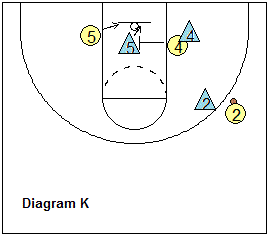
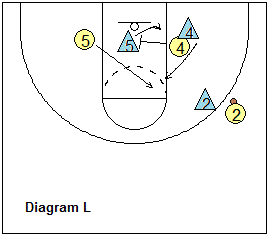
Definition: A post player screens for another post player - block to block. The screened defender always "steps under", one giant step back toward the baseline. We prefer to either "step under and stay" or "step under and switch".
Read: Which way does the cutter go, low (under) or high (over)?
Reaction 1: If the cutter goes low (baseline side), the screened defender gets an arm bar up and stays with her/his man (no switch).
Teaching cue: "low cut - step under and stay".
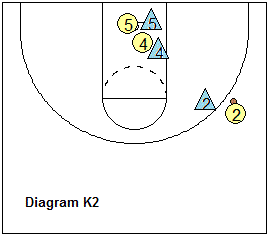
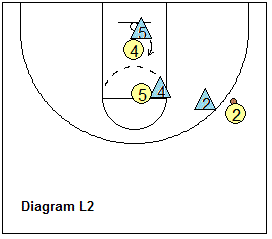
Reaction 2: If the cutter goes high (over the screen), then the defenders switch.
Teaching cue: "high cut - step under and switch".
After stepping-under, the screened defender steps around the screener into a fronting, denial position.
Tradeoff: if confusion or mis-communication occurs, the screened defender could get pinned inside.
- Staggered Screens
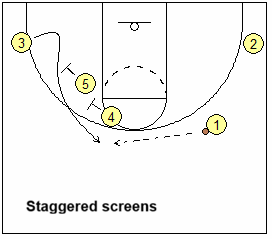
Definition: Two offensive players set successive screens for the same cutter.
Preferred Reaction: Call out both screens early. The cutter’s defender chases closely over the screens. The screeners’ defenders help contain the cutter while protecting against slips to the basket, then recover to their assignments.
Alternative: Switch according to your team’s coverage, communicating clearly so both the cutter and screeners remain covered.
Tradeoff: Too little help can free the cutter for a shot; too much can leave a screener open. Switching can create mismatches.
- Dribble Handoff (DHO)
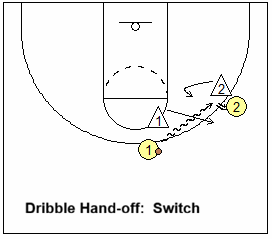
Definition: An offensive player dribbles toward a teammate and hands off the ball, often screening the receiving player's defender. Two defensive options are trapping and switching. Choose the coverage according to your personnel and team rules.
Reaction 1: Trapping the Handoff
The passer's defender and the receiver's defender trap the new ball-handler as the exchange occurs. Both defenders close together to contain the dribble and pressure the pass. Teammates rotate to cover the remaining threats.
Tradeoff: The passer may roll toward the basket or move into open space. If the offense passes out of the trap, the remaining defenders must cover a temporary numbers disadvantage.
Reaction 2: Switching Defenders
The defenders communicate the switch before the exchange. The passer's defender takes the receiver, while the receiver's defender takes the passer and protects against a roll or cut to the basket.
Tradeoff: Switching can create a size or quickness mismatch, especially when a post player hands off to a guard. Defenders must also be ready for a fake handoff or a receiver's backdoor cut.
4. Zone Reads and Responsibilities
Applies to: Zone defense • Responsibilities vary by alignmentPlayers must communicate effectively and react quickly to offensive movements. As the ball moves, defenders must shift together to cover gaps and prevent open shots. Rotate while pass is in the air. Here are some common reactions. See: Zone Defense
- High-Post Catch
Definition: A high-post catch puts the ball in the middle of the zone, where the receiver can shoot, drive, or pass behind the defense.
Read: Does the receiver face the basket? Is a player cutting behind the zone? Is the short corner occupied?
Reaction: The designated defender pressures the receiver. Teammates protect the basket and cover the next threats according to your zone's rotation rules.
Tradeoff: Collapsing everyone toward the ball can surrender an open perimeter shot; failing to protect behind the pressure can surrender a layup.
Teaching cue: "Pressure the catch. Protect behind it." - Short-corner catch
Definition: The short corner sits behind the defense and often between defenders, making it difficult for any single player to cover effectively. When the ball is in the short corner, players can drive to the basket for a layup, pass to a cutter moving towards the hoop, kick out to an open shooter on the perimeter.
Read: Is there a player cutting inside? Is the short corner player facing for a drive or shot?
Reaction: The zone rotation depends on which zone defense you are playing. In a 2-3 zone, the bottom ball-side defender should step out to contest a shot and cut off a drive from the short corner. The middle low defender moves to the ball-side block. The ball-side top defender slides inside to prevent a pass to the high post or cutter. Weakside defenders must anticipate and quickly rotate on skip-passes to the opposite wing.
Tradeoff: A ball-side low block cut from either the opposite block, or from the high post, can result in a pass and layup. - Overloads
Responsibilities vary by zone alignment
Definition: The offense places more offensive threats on one side of the floor than the zone can comfortably cover. Ball reversals, skip passes, and cuts are ways overloads are created.
Reaction: All zone defenders must communicate and know their rotations and assignments for ball movement. Rotate quickly when the pass is still in the air. Anticipate passes and clog the passing lanes, and close out quickly on shooters.
Tradeoff: Shifting extra defenders toward the overload can expose the opposite side, while staying home can leave a local numbers advantage. - Pin and Skip Pass
Definition: The pin screen is a weakside screen that is set on the back of a defender, pinning him inside and impeding his natural zone rotation when the ball is skip-passed across the defense. This allows for open weakside perimeter shots, and inside cuts. The image below shows a double pin and skip.

Reaction: Weakside defenders must anticipate when a skip pass is likely to occur and must communicate and quickly close out on shooters. Good anticipation might also lead to an interception of the skip pass. One 2-3 zone approach favors the screened defender fighting around the screen to close out on the ball in the corner, while the adjacent (middle) low defender slides baseline ball-side to cover the vacated area and deny the pass inside.
Tradeoff: if the low weakside (screened) defender fights around the screen to close out on the ball, a layup could result unless someone rotates quickly to defend the pass into the low post.

- Skip pass to Opposite Wing
Definition: Wing or corner player with ball skip-passes across the top to the opposite wing, often resulting in an open shooter.
Reaction: In a 2-3 zone, the weakside wing defender anticipates this pass and sprints quickly to close out. The weakside low defender goes "on and off" - he first sprints out and closes-out "on" the ball, and then quickly retreats "off" back inside when the wing defender arrives.
Tradeoff: if players rotate too slowly, they give up an open 3-point shot, or even a quick pass inside. - Cutters
Definition: player cuts through paint, or along the baseline.
Reaction: Defenders must communicate to track and tag cutters and deny a pass to the cutter, especially inside baseline cutters.
Tradeoff: If defenders are not aware of what is behind them, a baseline cutter could slip inside for a quick pass and layup. A cutter moving into the high post might have an easy pass and catch, or quick pass to the low post. - Shot and rebound
Reaction: The on-ball defender blocks out the shooter. Inside defenders find an opponent and block out for inside rebounding position (but not too far under the basket), making sure we have a weakside rebounder. In a 2-3 zone, we favor the opposite guard defender getting to the free throw line, or weakside elbow anticipating a long rebound. See Zone Rebounding.
Related pages:
Want More Coaching Content?
Get access to more complete articles, diagrams, and coaching tools with Premium Membership.
View Membership Options


