OK... now down to playing basketball! Let's put together a team.
First, you probably have limited practice time at this age. So don't try to accomplish too much, and keep things simple.Practices for younger children should probably be no longer that 60 to 90 minutes because of their short attention span. So what are you going to teach them? What are your priorities? Others may disagree with me, but here are some of my thoughts.
Let's start with this timeless message to youth coaches from Coach Stan Van Gundy.
Teach the fundamentals
At every practice, do ten minutes of ball-handling and dribbling drills. Do simple passing drills. Teach footwork (pivoting, triple threat position, doing lay-ups, how to shuffle and slide on defense, etc).Correct shooting form will be difficult to teach at very young ages, since it will just be an effort to get the ball up to the hoop! But start working on correct form when the kids are strong enough... maybe 6th-7th grade. Teach man to man defense and how to box out and rebound.
Team Offense
With a limited number of practices, find out who can dribble and handle the ball... they are your point guards and wings. Put them in a simple "3-out, 2-in" set (a point guard, left and right wings, and two post players), or bring one of the posts up to the free throw line... hence a 1-3-1 set. Or use a 4-out, 1-in set.I like Betterbasketball.com's "Read and React Offense" for teaching kids how to play... just teach the first two or three "layers".
Teach them the numbering quickly... 1 is the point, 2 is the right wing and 4 the right post, and 3 the left wing and 5 the left post (the even numbers are on the right side and the odd numbers on the left). The only reason to put them into a set is to try to maintain some spacing on the floor... so all five don't end up in the right corner!
But tell them that they must not stand still in their position, but cut and move. Don't teach any plays except maybe a simple out-of-bounds play. They will not execute plays at this age anyway. Let them just "play".
I have a "first shot mentality" with kids this age... in other words, the player with the first open shot within his/her shooting range, should take the shot. This has several advantages. If they do too much passing at this age, they will eventually throw the ball away or commit a turnover, and you don't get a shot.
So shoot early, and crash the offensive boards for second and third chances. It's a little like ice hockey at this age... the team with the most "shots on goal" usually wins.
"First shot mentality" also takes the pressure off the kids (some kids are afraid to shoot, afraid to miss). If you teach the kids that you expect them to shoot when they are open, and that you don't expect them to make all their shots (even Michael Jordan only makes half of 'em) they will play more relaxed and better.
Let them know that you don't expect them to make every shot... but that you do expect them to shoot when they are open, and everybody rebounds (maybe one guard back). Teach them that part of being a good "team" player is taking good shots. So nothing fancy on offense... just a simple set, spacing, cutting, an early shot and crash the boards for more shots. If they are quick, fast break for easy lay-ups too.
Team Defense
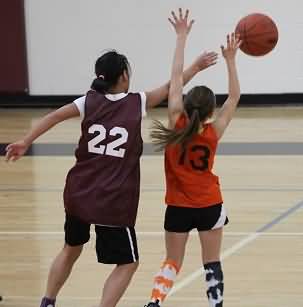
I believe all young kids should first learn to play man-to-man defense before learning zones. With the really young kids, just teach on-ball defense. With 6th graders, start teaching "on-ball", "deny" and "helpside" concepts (read "Basic Defense").Now having said this, you could probably win most of your games by using a 2-1-2 (or 2-3) zone defense because at this age most baskets will be made inside the paint. If you pack the paint with your defense, you will shut them down... there is little outside scoring at this age.
Our town's recreational league does not permit zone defenses at the younger ages. Double-teaming is not allowed, except in the paint. The kids will become better defensive players if they learn to move their feet and learn to play good man defense.
Even playing man-to-man you can clog the paint. Just tell the kids that the paint is the "blood and guts" area that they must defend... that's where most scores will occur. So whenever there is an offensive player in the paint, a warning bell should ring in their heads that this player is a threat to score if he/she gets the ball... so deny this pass.
When an offensive player dribble penetrates, other defenders should collapse on him/her and "help". Also, when a player dribbles around the right corner (they always do), don't let him/her penetrate along the baseline... stop it there and trap.
Full-court press
First, full court pressing probably should not be permitted with younger kids. But if you are permitted to full court press, use former Oregon State legend Ralph Miller's "pressure defense".I have used this with middle school kids and it works great, and is very easy to understand and teach. You will get steals and turnovers in the backcourt that you can quickly convert into easy lay-ups. It is simply a full-court man-to-man defense, so it flows easily into your half-court man-to-man defense.
Simply, you pressure the ball handler, and the other players try to deny a pass to their man. Oftentimes the young inexperienced guards will throw the ball away, or make some other turnover, but just applying a little gentle pressure. Don't let them dribble the ball uncontested up the floor... apply a little harassment.
Don't teach a lot of trapping and gambling... just everyone plays good man-to-man pressure. Now, this is important... if they see the ball advancing quickly up the court (a good dribbler, or a good pass), then everybody sprints back as fast as they can to the paint (the old "blood and guts" area) and tries to stop them from getting the lay-up.
Then, after stopping the lay-up, everyone can fan out and pick up his/her man. So when you are beat on the press, you must sprint back. Tell them that if they don't sprint back, you will assume that they are tired and will sit them down for a rest! By playing full-court defense, they will tire easier and actually want rest, and this is good for getting all your players in the game.
Substituting
Try to figure out who your best players are. When you substitute, always have two good players out there... someone who can dribble and get the ball down the floor, and someone who can rebound and play tough defense "in the paint".I often have my assistant make most of the substitutions. You are too busy trying to "coach" the game to keep track of everyone's playing time... your assistant can be a big help here. Discuss with your assistant before the game who your starters will be, and your general substitution pattern (who plays what positions, etc), and then let him do it... you can always over-ride him in a given game situation.
With young players, let everyone on the team have a chance to start at least one game during the season. I tell the kids, "its not who starts... it's who can finish the game". My players don't seem to care who starts because they know that they are all going to get to play. Believe it or not, I have even had some say, "Coach, let Jessica start this game, because I started the last one"... kids can be so neat!
Basketball coaching articles that may help
(but don't try to do too much too soon!):See: Pre-season Middle School/Youth Practice Plan
Dribbling, ball handling:
Ball-Handling
Dribbling
Basic Dribbling Drills
Sideline Dribbling Drills
Ball-Handling
Dribbling
Basic Dribbling Drills
Sideline Dribbling Drills
Passing:
Half-Court Passing Drills
Fast-Break Passing Drills
Full-Court Weave Passing Drills
Defense:
Basic Defense
Pressure Defense
Transition Defense
Footwork
Defense 1 on 1 Drill
Shell Drill
Z-Drill and Lane Slides
Defensive Tips
Rebounding
Offense:
3-2 Motion Offense (keep this very simple!)
4-Out Motion Offense (keep this very simple!)
Read and React Offense (first few layers).
1-3-1 Motion
Offensive Tips
The Lay-up
Lay-up Drills
Teaching/Learning How to Shoot
2-Man Shooting Drills
Setting Screens
Screen, Pick Drills
3-2 Motion Offense (keep this very simple!)
4-Out Motion Offense (keep this very simple!)
Read and React Offense (first few layers).
1-3-1 Motion
Offensive Tips
The Lay-up
Lay-up Drills
Teaching/Learning How to Shoot
2-Man Shooting Drills
Setting Screens
Screen, Pick Drills
Out-of-bounds plays:
Man-to-man inbounds plays
Zone inbounds plays
Coaching:
Pre-game
Game coaching
Good luck! Have fun!


