From the Coach's Clipboard Basketball Playbook
This practice plan uses six stations to evaluate and develop the primary basketball skills: shooting, lay-ups, passing, dribbling, footwork, and defense. Use all six baskets. Players should rotate through each station at a set time, with one coach or assistant supervising each area when possible.
This 90-minute plan could be used any time during the season, but typically is useful in the early season, or pre-season, or as a try-out.
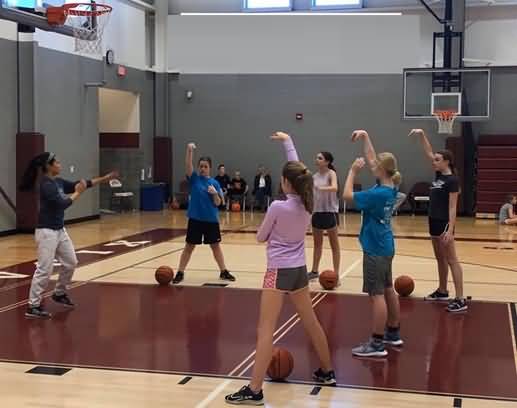
Introduction and Dynamic Warm-Up — 10 minutes
This segment can use the whole gym and appplies to the entire group (not yet broken up into six smaller groups).- Jogging, slides, skips, and backpedaling
- High knees and defensive stance movements
- Ball-handling in place:
- Right-hand pound dribbles
- Left-hand pound dribbles
- Crossovers
- Between-the-legs dribbles
Station Work — 48 Minutes
Format: Six stations, eight minutes each, with one-minute rotations.Station 1: Shooting
Organization- Use one basket if possible.
- Place players in shooting and rebounding lines.
- Begin with shots close to the basket before moving farther away.
- Form shooting from both sides of the basket
- One-dribble pull-ups from the elbows
- Catch-and-shoot from short corner or wing
- Free throws during the final minute
- Square the feet and shoulders to the basket.
- Keep the shooting elbow underneath the ball.
- Finish with a high follow-through.
- Hold the finish and track the ball.
- Rebounders should make strong outlet passes.
Station 2: Lay-Ups and Finishing
Organization- Create right- and left-side lay-up lines.
- Add a passer or coach near the top of the key.
- Players retrieve their own rebounds and join the opposite line.
- Right-hand lay-ups
- Left-hand lay-ups
- Lay-ups after receiving a pass
- Reverse lay-ups or inside-hand finishes, if appropriate for the age group.
- Approach the basket under control.
- Use the correct two-step rhythm.
- Jump off the proper foot.
- Aim for the upper corner of the backboard.
- Finish through contact without losing balance.
- Players should practice both sides of the basket.
Station 3: Passing
OrganizationPair players or use three-player passing groups. Keep players moving rather than standing for long periods.
Activities
- Partner chest passes
- Bounce passes while moving
- Two-handed overhead passes
- Full-court two-line passing
- Pass-and-cut or pass-and-follow
- Step toward the receiver.
- Pass to the receiver’s chest or leading shoulder.
- Use a target hand and communicate.
- Catch with two hands and move into triple-threat position.
- Avoid soft, floating, or telegraphed passes.
- Players should move immediately after passing.
Station 4: Dribbling and Ball-Handling
Organization- Use cones to create lanes.
- Players work in pairs if there are not enough basketballs.
- Have players go down and back before switching with a partner.
- Control dribble with the right hand
- Control dribble with the left hand
- Speed dribble
- Crossover at a cone
- Hesitation or rocker-step move
- In-and-out dribble
- Keep the head up and eyes forward.
- Use the fingertips rather than the palm.
- Keep the ball below the waist when changing direction.
- Protect the ball with the body and off-hand.
- Change speed and direction—not just hands.
- Encourage players to use both hands.
Station 5: Footwork
OrganizationSet up cones, a jump-stop area, and a pivoting space. Players work continuously for short repetitions.
Activities
- Jump-stop on command
- Front and reverse pivots
- Triple-threat position
- Jab step and drive step
- Defensive slides between cones
- Close-out to a coach or partner
- Maintain a low, balanced stance.
- Stop under control with two feet.
- Keep the pivot foot planted.
- Use short, quick steps when defending.
- Close out with high hands and controlled footwork.
- Do not cross the feet while sliding.
Station 6: Defense
OrganizationUse cones or offensive players to create short one-on-one defensive repetitions.
Activities
- Defensive stance and slides
- Close-out to a shooter
- Contain the ball-handler for five seconds
- Cut off baseline or middle penetration
- Defensive help-and-recover
- Finish with a box-out
- Begin in a low stance with active hands.
- Keep the chest in front of the ball-handler.
- Slide instead of reaching.
- Force the ball toward the designated direction.
- Communicate when helping or recovering.
- Make contact and pursue the rebound after every shot.
Competitive Shooting or Skills Challenge — 8 Minutes
Choose one challenge:- First group to make 10 team baskets
- Two-minute lay-up competition
- Passing accuracy competition
- Dribble-course relay
- Defensive slide and close-out competition
Small-Sided Scrimmage — 18 Minutes
Play 3-on-3 or 4-on-4 games, depending on the number of players. Small-sided games give each player more opportunities to handle the ball, defend, rebound, and make decisions. They also help coaches evaluate competitiveness and game instincts that may not appear during isolated drills.Suggested rules:
- Play games to three or five baskets.
- Require every player to touch the ball before a shot.
- Award an extra point for a defensive stop followed by a rebound.
- No pressing for younger or beginning players.
- Rotate teams so players compete with and against different teammates.
- Emphasize spacing, passing, cutting, help defense, and rebounding.
Cool-Down and Review — 6 Minutes
- Light jogging and stretching
- Ask players to identify one skill they improved.
- Review two team priorities, such as:
- Make the extra pass.
- Sprint back on defense.
- Communicate on every possession.
- End with a positive team message.
Coaching Notes
- Demonstrate each station briefly before beginning.
- Keep lines short and players active.
- Move groups quickly at the sound of a whistle.
- Adjust the time at each station based on player numbers and available baskets.
- If there are not enough coaches for every basket, run dribbling or footwork stations along the sideline for the entire group.
- During evaluations, observe effort, focus, athleticism, decision-making, competitiveness, communication, and willingness to defend—not only technical skill.
Related page:
Want More Coaching Content?
Get access to more complete articles, diagrams, and coaching tools with Premium Membership.
View Membership Options


