From the Coach's Clipboard Basketball Playbook

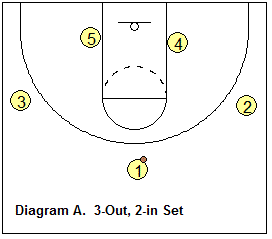
Use this offense if you have two good, solid post players. We will tweak this basic offense from season to season and add special plays for our better scorers. If the play falls apart, we just resume this basic motion offense. See "Motion Offense" for basic motion principles.
On this page:
Perimeter play
Perimeter players should catch the ball in triple-threat position, and then (1) look to shoot, (2) look into the post, and (3) look to jab-step or shot-fake and dribble-penetrate. This is very important, as too often, especially early in the season, players will catch the pass and start dribbling. After receiving the pass, read the defender. If the defender is sagging off, hit the outside shot. If the defender is up tight, attack with a dribble move. If the defender is flying out at you, shot-fake and dribble around for a mid-range jump-shot (or a take to the hoop).On dribble-penetration, make the correct decision. Sometimes our guards will make a nice move around the defender, but then take it all the way up the middle of the paint to the hoop, where he/she is met by a tall defender (or two) and either gets the shot blocked or turns it over in traffic. Instead (especially vs a 2-3 zone), dribble-penetrate and pull-up with a jump-stop just inside the lane, low arc area and take the short jump shot in the lane - a high-percentage shot with our rebounders in place down low. Or if you are good at it, shoot a floater in the paint. Guards must learn when to go to the hoop, when to pull-up, or when to pass to a post player inside, or when to kick a pass out to the opposite wing or corner.
Tips on passing into the low post - the wing player with the ball reads the post defender.
- If the post defender is playing behind our post player, pass it in.
- If the defender is fronting from the top, then curl-bounce pass from the base-line side.
- If the defender is fronting from the base-line side then make one dribble toward the top and feed from the top.
- If the defender is full-fronting, don't force the pass. Pass back to the point, or skip-pass to the opposite wing, or pass to the weak-side post cutting to the ball-side elbow (see diagram PP4) below.
After feeding the post, the wing player slides to the corner for the possible pass back out. See these post feed drills for details.
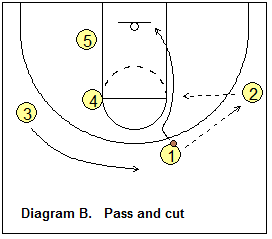
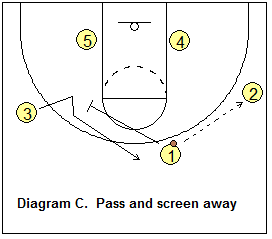
Move! Get open! Perimeter players should use v-cuts, back-cuts and screens to get open. Don't stand still! Screen for each other. Pass and cut (diagram B). Pass and screen-away (diagram C). Fill the open spots on the perimeter. Maintain good spacing at all times and keep the defense spread out. An outside player can make a cut inside, but should not stay inside and clog things up for other players. For example, (diagram B) if O1 cuts inside and does not receive the ball, he/she should immediately move out to the opposite corner/wing, while the wing player O3 fills the spot at the point.
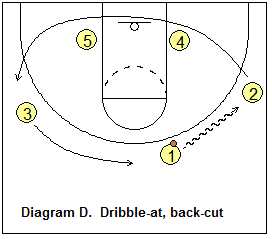
"Dribble-at" rule: If a teammate is dribbling at you, back-cut through to the opposite side (diagram D). The exception is if we are running a weave-screen (dribble handoff - DHO) play (see below).
Point to wing pass denial: If the pass to the wing is being denied, O1 can dribble the ball to the wing instead. Following our "dribble-at" rule, the wing back-cuts. He/she could either (1) cut through to the opposite side (diagram D) as the opposite wing O3 fills the top spot, or (2) make an exchange shallow cut inside and then out to the point (O1 and O2 exchange spots). When the wing pass is denied, you can also run (1) a weave-screen play.
A simple weave-screen play (dribble hand-off, DHO) is an effective way to set up an outside shooter for a 3-pointer, or for a dribble-drive into the paint. Here we use this play with the 3-out, 2-in set but you can run it from any set, including the 4-out, 1-in motion offense or the 5-out open post motion offense.
Another situation where this is helpful is when the wing defender is denying the pass to the wing. With this play, you don't have to pass the ball to the wing. It's just a simple, old-fashioned weave-type hand-off from the point guard to the wing player, with the point guard setting the screen.
Post play
Post players work together, screening for each other and reading what each other is doing. Whenever a post player gets the ball inside in a 1-on-1 situation, the opposite post slides up to the weak-side elbow. This creates better spacing so our post player can score (or get fouled).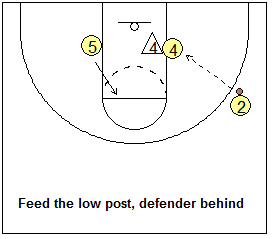
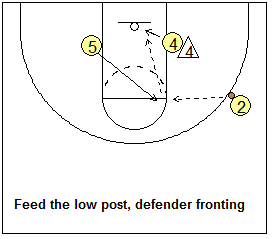
If the low post is fronted and denied, the opposite post flashes to the ballside elbow for the pass. Now we can go "hi-lo" to the low post, who seals his/her defender for inside position. Our high post player could also shoot, or make a dribble move around the defender (to the open side of the lane).
When the ball is on the wing, the ballside post player fights for position in the low post. If he/she can't get open within a count of 2, he/she should screen away for the opposite post player (who then cuts to the ball-side low post looking for the pass).
If the cutter is not open, he/she moves out to the short corner, as the screener seals and looks for the pass from the wing.
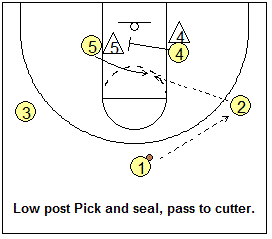
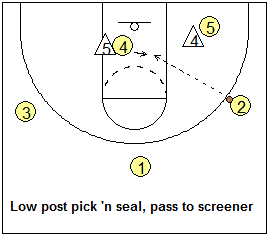
Two rules for post players on dribble-penetration:
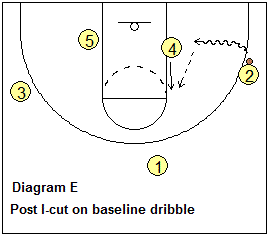
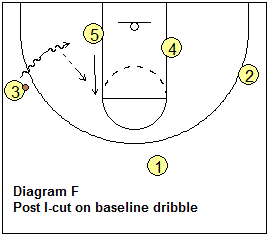
- Base-line dribble penetration. (Diagrams E and F) If the ball is on the wing and the wing player makes a dribble-move to the base-line, the ball-side post player should slide-up, or "I-cut", to the ball-side elbow, not only to clear out for the dribbler, but also for a possible pass to the elbow for a shot.
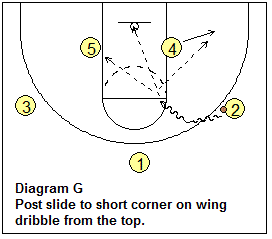
- Dribble-penetration from the top. (Diagram G) If the ball is on the wing and the wing player makes a dribble move into the top seam, the ball-side post player slides to the short corner, again for spacing, and also for a possible pass and shot there.
Starting the Offense - Off the Break
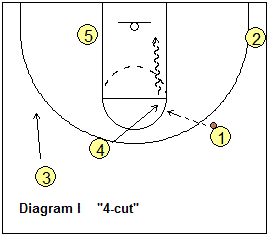
Our first look after coming up the court is off the break with our point guard O1 looking to "take the seam" with a 1-on-1 dribble move up the right lane line to the hoop (diagram H) - much like in the dribble-drive motion offense. Our secondary break (diagram H) starts as 4-out with O2 deep in the right corner, O5 opposite low block, O4 at the top (3-point arc) left lane line extended, and O3 (our inbounds passer) is trailing to the left side.O1 looks at the seam looking to make a dribble-move up the right lane line. O4 reads O1 and waits to give O1 a chance to take that open seam up the right side of the lane. If O4 cuts too soon, there will be no open lane for O1 to penetrate. If O1 pulls up, then O4 makes the "4-cut" (diagram I), cutting through looking for a pass from O1, and ends up at the right low block, and we are now in our 3-2 set.
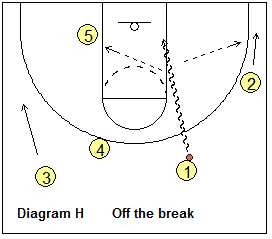
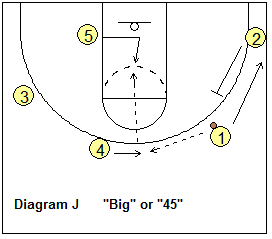
Also notice in diagram H, that once O3 fills the left wing-corner area, we are initially 4-out. This is a good time to run one of our "Big" plays, a hi-lo play involving O4 and O5 (diagram J).
Running the basic pattern
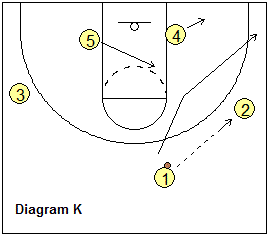
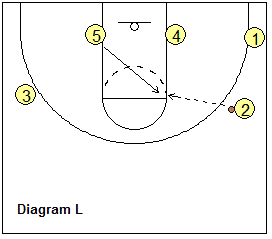
This is a good way to run the offense if you have a talented wing player (O2 or O3). After the 4-cut, we start with O1 passing to either wing, and then shallow cutting thru to the ball-side corner (diagram K). In diagram L, the opposite post player (O5) flashes to the top or ball-side elbow looking for the pass from the wing.If O5 gets the pass, he/she looks inside to O4, or considers a shot there, or a dribble move up the opposite side of the lane, or a pass out to the opposite wing O3. You could also have O2 follow his/her pass for a possible hand-off from O5 - if no hand-off, O2 goes to the opposite corner-wing, while O3 moves up top.
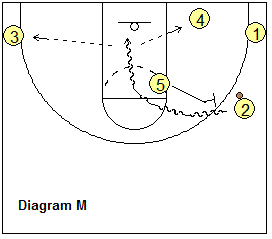
In diagram M, if the high post player O5 does not get the pass, he/she ball-screens for the wing O2, who makes a dribble-move around the screen for the jump shot or take to the hoop. O4 slides to the short corner and might get a bounce pass from O2 inside. If the X3 defender drops inside, kick it out to O3 for a shot. After ball-screening, O5 pops out to the top.


